
mean solar time
- noun
- /miːn ˈsoʊlər taɪm/
- Specialized
- International time zones are often based on mean solar time at a central longitude.
Examples
-
The clock is set to mean solar time.
-
Before atomic clocks, most cities set their clocks according to mean solar time.
-
Greenwich mean solar time served as the world standard for many years.
-
What is mean solar time?
-
The clock on the wall shows the local mean solar time, which helps us keep track of the day.
-
Scientists use mean solar time to ensure that all timekeeping systems remain synchronized.
-
In ancient cultures, they calculated mean solar time to guide their daily activities according to the sun's position.
Synonyms

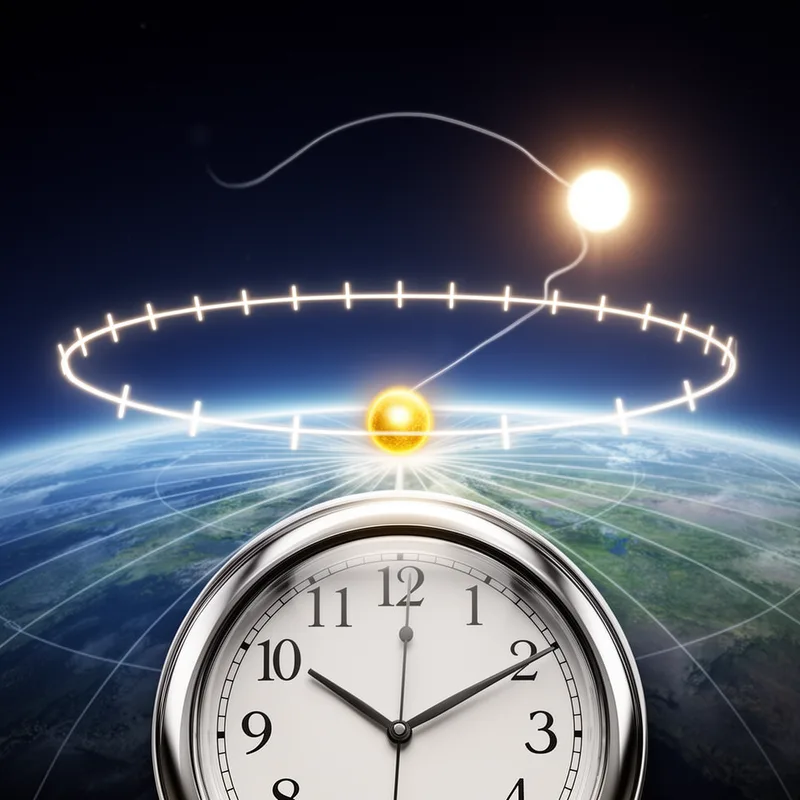
Time kept by an imaginary sun that moves evenly across the sky to set clocks
Surface Forms
Morphology
The three constituents combine compositionally: 'solar time' clearly means time based on the sun, and 'mean' signals an averaged or standardized form of that time. A B1 learner who knows 'mean', 'solar', and 'time' can reasonably infer it denotes an averaged/standardized sun-based time even if they lack the technical astronomical details.
Etymology
Mean solar time comes from the idea of an imagined, steady mean 'average' solar sun that moves at a fixed pace so people could set clocks. The real sun moves a little faster or slower during the year, so this 'mean' sun became a simple standard for keeping time.

