
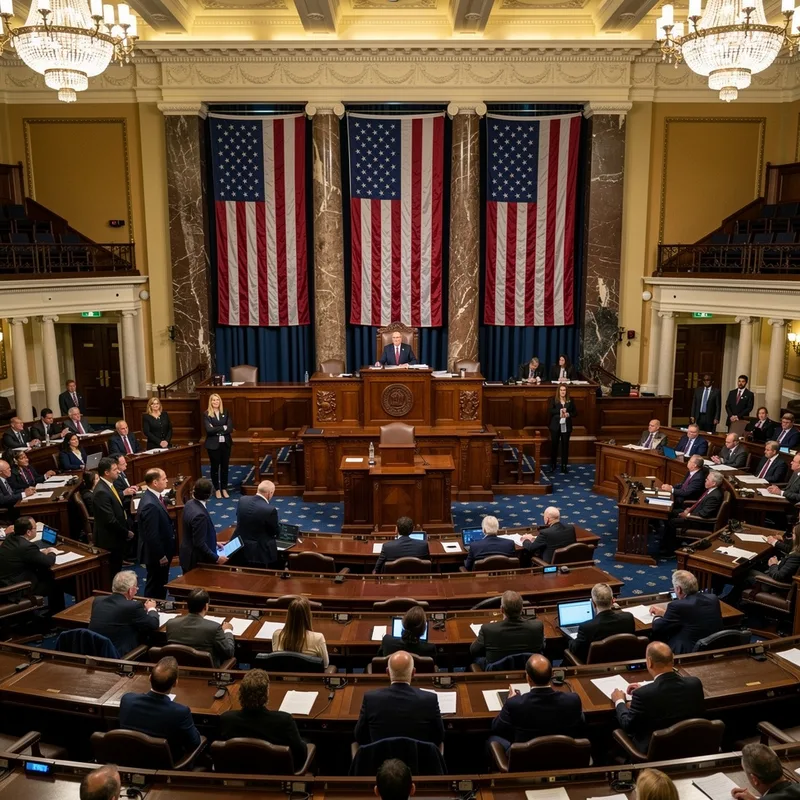
U.S. Congress
 28
2.5
28
2.5

- noun
- /juː ɛs ˈkɒŋɡrɛs/
- Members of the U.S. Congress debated the new healthcare bill for hours before voting.
- U.S. Congress passed
- members of the U.S. Congress
- approved by the U.S. Congress
Examples
-
The U.S. Congress is responsible for making federal laws in the United States.
-
Yet, somehow, all of this would be solved if the U.S. Congress spent less on defense.
Blog text (5) -
"This was when the U.S. Congress passed the Clean Air Act. "
-
The bill has been called the most significant single piece of legislation to pass the U.S. Congress in this century.
Academic text (1992) -
If passed, they would then have to submit a constitution to the U.S. Congress to be approved.
Blog text (8) -
The U.S. Congress held hearings in January 1992 and initiated UN action in the Security Council.
Academic text (1993) -
On June 18, 1812, the U.S. Congress agreed to President James Madison's request for a declaration of war against Britain.
Fiction book (1999) -
After intensive lobbying by Taiwan, the U.S. Congress passed the Taiwan Relations Act, which became Public Law 96-8.
Academic text (1999) -
The Carol M. White Physical Education Program originated in 2001, when the U.S. Congress appropriated $400 million over a 5-year period.
Academic text (2012) -
During his speech, the president urged the U.S. Congress to take action on climate change.
Synonyms
 356
5.3
356
5.3
A group of people who make and change the laws of a country or region
 24
2.5
24
2.5
A national group of elected people who make United States laws and includes the Senate and House of Representatives
 14
3.6
14
3.6
The part of government that makes laws
 10
3.0
10
3.0
A national body that makes laws, including the Senate and the House of Representatives
 8
4.5
8
4.5
An official group of people who make and change laws for a country or state
 5
3.7
5
3.7
The national group of elected people who make and change laws
Surface Forms
Morphology
The meaning is directly and literally derived from combining 'U.S.' (denoting the United States/federal) with 'Congress' (a legislature), so it straightforwardly denotes the United States legislature. This compositional, referential pattern is common cross-linguistically, so a B1 learner who knows both constituents will readily understand the MWE.
Etymology
U.S. Congress comes from the word congress, which originally meant a 'meeting' of people who come together to decide things. Picture the two groups, the Senate and the House, sitting and talking to 'make laws', so U.S. Congress means the national group that makes the country's laws.