

Six-Day War
 1
5.7
1
5.7

- noun
- /sɪks deɪ wɔr/
- Arabist influence continued to diminish with the crisis leading up to the Six-Day War.
- the Six-Day War of 1967
- the Six-Day War in Israel
- the Six-Day War in June
Examples
-
Conquered by Israel in 1967 during the Six-Day War, the West Bank was never officially annexed.
Academic text (1996) -
The previous broad-based coalition was formed on the eve of the Six-Day War in 1967.
Academic text (1994) -
In this so-called Six-Day War, the United States for the first time gave military weapons to Israel.
Blog text (31) -
Among these is the Israeli attack on the U.S.S. Liberty that took place during the 1967 Six-Day War.
Academic text (1991) -
The reality is that Israel captured 60,000 square kilometers of Egyptian land because of the Six-Day War.
-
Most Israelis were relieved that the new territories they had gained from the Six-Day War gave the appearance of greater military security.
Academic text (1991) -
After the Six-Day War, Israeli archaeologists discovered a buried passageway near the Western Wall.
Academic text (1998) -
Since the 1967 Six-Day War, Israel has relied on military force to suppress Palestinian demands for a homeland.
Academic text (2005) -
In June 1967, on the second day of the Six-Day War, Israeli paratroopers entered Jerusalem's Old City and made their way to the Temple Mount.
Academic text (2013) -
The Six-Day War in 1967 reshaped the political landscape of the Middle East significantly.
Synonyms
 3
5.8
3
5.8
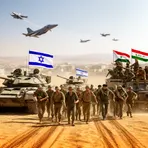
A war in June 1967 that lasted six days between Israel and nearby Arab countries and changed the region

 1
5.7
1
5.7
A short war in June 1967 when Israel fought nearby Arab countries and won
Surface Forms
Morphology
Six-Day + war
The compound plainly combines a duration ('six-day') with 'war', so a learner who knows the words can infer it refers to a war lasting six days. However, as a proper name for a specific 1967 conflict (participants, date, political significance) the full referential meaning requires historical/world knowledge beyond the constituent meanings, making it only partially predictable.
Etymology
Six-Day War gets its name because the fighting lasted just six days in June 1967 between Israel and nearby Arab countries. Imagine armies moving and borders changing in less than a week; that's why the name shows it was a 'short' but important war.