
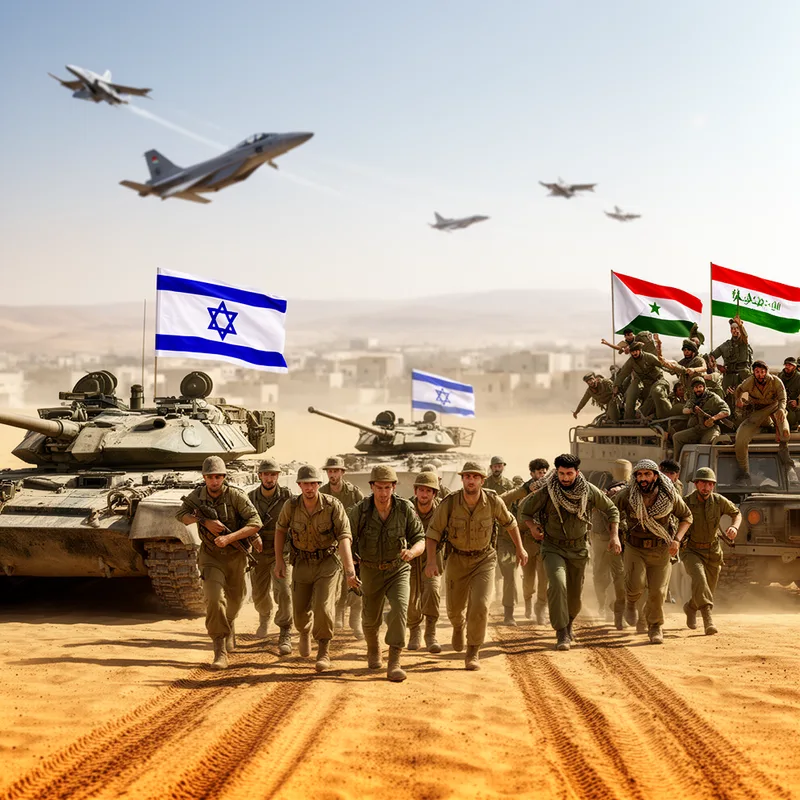
Arab-Israeli War


 1
5.7
1
5.7
- noun
- /ˈærəb ɪzˈreɪli wɔr/
- These activities, in turn, set in motion the train of events which triggered the six-day Arab-Israeli War of June 5-10, 1967.
- the 1967 Arab-Israeli War
- the Arab-Israeli War of June
Examples
-
Many historians consider the Arab-Israeli War of 1967 a pivotal moment in Middle Eastern history.
-
The 1967 Arab-Israeli War and the Israeli occupation of the West Bank, Gaza Strip, Sinai, and Golan Heights raised the confrontation from strategic to national importance for border states.
Academic text (1999) -
The turning point came with the shift toward a seller's market triggered by the Arab-Israeli War of 1967.
Academic text (1993) -
After the 1967 Arab-Israeli War, however, Beirut also began to decline as a press center.
Academic text (1993) -
This resolution was anathema to the Palestinians because it denied their claim to Palestine and acknowledged only the right of Arab states to retrieve lands lost in the 1967 Arab-Israeli War.
Academic text (1993) -
The 1967 Arab-Israeli War resulted in significant territorial changes in the region.
-
Following the Arab-Israeli War, tensions between Israel and its neighbors intensified dramatically.
Synonyms
 1
5.7
1
5.7
A short war in June 1967 between Israel and nearby Arab countries that changed control of land
Surface Forms
Morphology
Arab-Israeli + war
The meaning is directly compositional: 'Arab-Israeli' denotes involvement of Arabs and Israelis and 'war' denotes an armed conflict, so a learner who knows the constituent words can infer it refers to a conflict between Arab states and Israel. Although the label can refer to different historical conflicts, the underlying semantic relation is transparent and follows a common cross-linguistic pattern of party1-party2 + war.
Etymology
Arab-Israeli War refers to a war between Arab countries and Israel. One clear memory hook is the 1967 conflict in June that lasted only six days, so people often call that event the 'Six-Day War', and the name Arab-Israeli War simply points to the two sides in that short conflict.