

Senna alata
- noun
- Specialized
- The leaves of Senna alata are widely used in traditional medicine to treat skin infections.
Examples
-
The juice extracted from Senna alata leaves is commonly applied to poisonous bites for relief and healing.
-
In the botanical garden, Senna alata stands out for its striking yellow flowers and lush foliage.
-
Researchers are studying Senna alata for its potential antifungal properties.
-
The Senna alata plant is known for its medicinal properties.
-
Many herbalists recommend Senna alata for treating skin infections.
-
In traditional medicine, Senna alata is often used to effectively treat ringworm due to its antifungal properties.
-
Known for its large leaves, Senna alata is frequently grown in gardens for its stunning yellow flowers and medicinal uses.
Synonyms
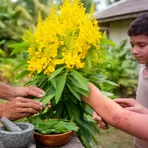
A tropical shrub with bright yellow flowers and leaves people use to treat skin infections

A tropical shrub with yellow flowers and large leaves whose juice treats skin infections and poisonous bites
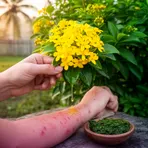
Tropical shrub with yellow flowers whose juice treats skin rashes and insect bites

A tropical shrub with large leaves and yellow flowers whose juice people use to treat skin infections and poisonous bites
Surface Forms
Morphology
Senna + alata
This is a Latin binomial (genus + specific epithet) functioning as a scientific proper name; the species identity and its medicinal properties cannot be inferred from the surface parts. The second element 'alata' is a Latin adjective not known to an average B1 learner, and even knowing 'Senna' as a plant genus does not let learners derive the full meaning or medicinal uses, so the expression is opaque.
Etymology
Senna alata mixes the plant group name Senna with the Latin word alata, which means 'winged', a useful image because the leaves have wide, wing-like edges. People used the leaves' juice to treat skin problems like 'ringworm', so the name reminds us of both the winged leaves and its use as a skin medicine.

