
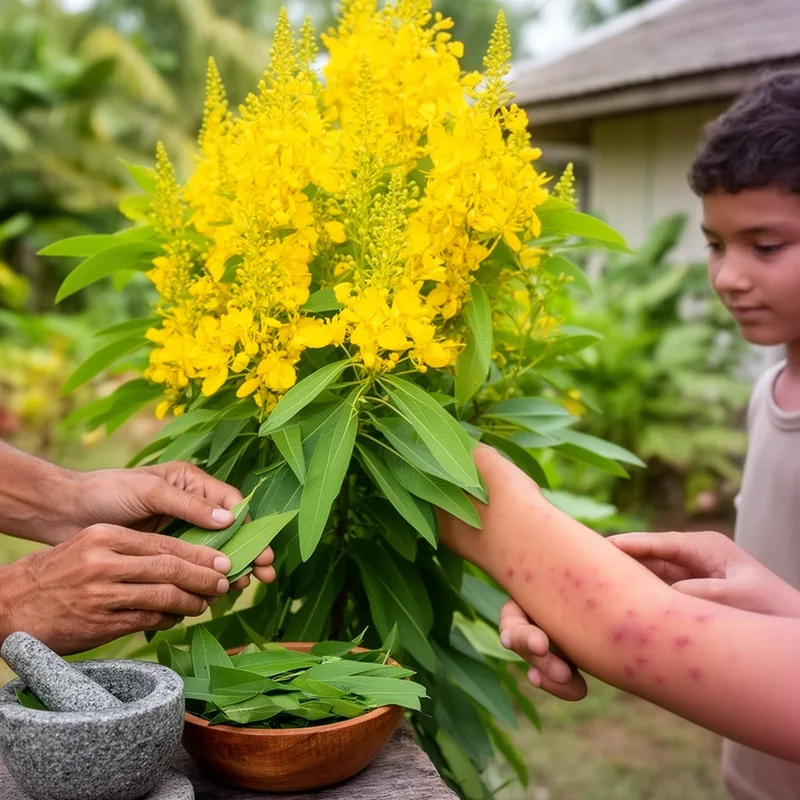
Cassia alata
- noun
- Specialized
- The leaves of Cassia alata are commonly used in herbal remedies to treat ringworm and other skin infections.
Examples
-
The leaves of Cassia alata are commonly used in herbal remedies for skin infections.
-
The Cassia alata shrub thrives in tropical climates.
-
Many gardeners appreciate Cassia alata for its bright yellow flowers and rapid growth.
-
Traditional healers in tropical regions still use Cassia alata to treat fungal diseases.
-
Many gardeners love to grow Cassia alata for its beautiful flowers.
-
Traditional healers in tropical regions rely on Cassia alata to treat poisonous bites and fungal ailments.
-
Many people use extracts from Cassia alata for its medicinal properties in treating various skin conditions.
Synonyms

A tropical bush with yellow flowers whose leaves are used to treat skin infections and bites

A tropical shrub with yellow flowers and large leaves whose juice treats skin infections and poisonous bites
Tropical shrub with yellow flowers whose juice treats skin rashes and insect bites

A tropical shrub with large leaves and yellow flowers whose juice people use to treat skin infections and poisonous bites
Surface Forms
Morphology
Cassia + alata
This is a Latin binomial (scientific) name rather than a compositional English phrase; the specific sense 'a tropical shrub used in traditional medicine' cannot be derived from the parts. The second element 'alata' is not a common English word (and is undefined here), so an average B1 learner who knows the constituent tokens would not be able to infer the plant meaning.
Etymology
Cassia alata comes from old words: Cassia was a name for sweet‑smelling plants like cinnamon, and alata is Latin for 'winged' because the plant's large leaves and seed pods have a wing-like shape. So the name points to both its plant family and its wing-like parts.

