
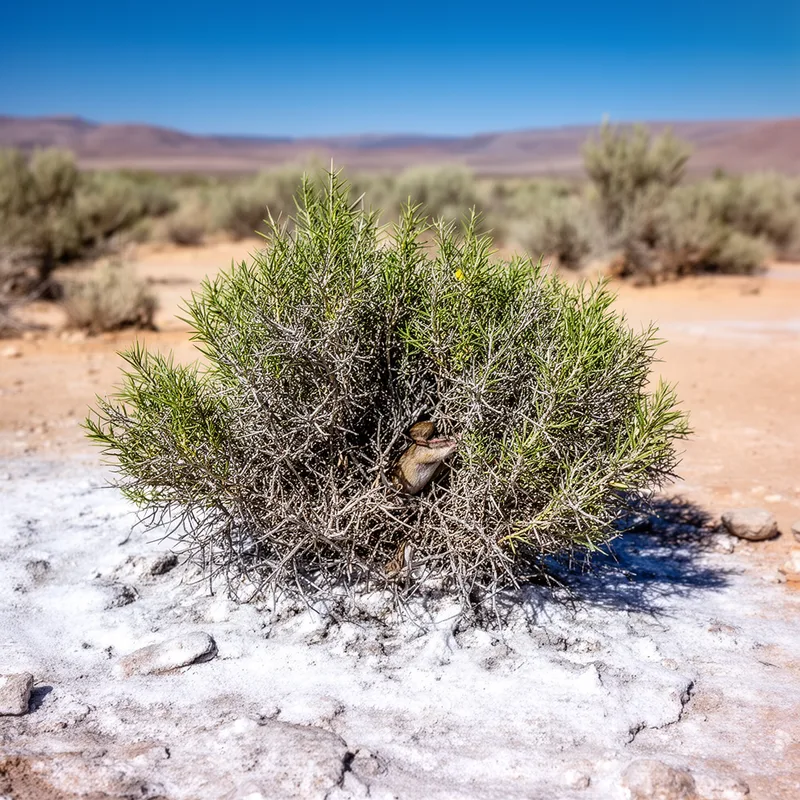
Sarcobatus vermiculatus
- noun
- Specialized
- Sarcobatus vermiculatus is a hardy shrub that grows in the alkaline soils of the western United States.
Examples
-
The alkaline soil was dominated by Sarcobatus vermiculatus and sagebrush.
-
Many birds and small mammals use Sarcobatus vermiculatus as shelter in the harsh desert climate.
-
Sarcobatus vermiculatus is often found in salt flats and desert valleys across Nevada and Utah.
-
The Sarcobatus vermiculatus thrives in harsh, alkaline environments.
-
Many Sarcobatus vermiculatuses can be found in the Great Basin.
-
The roots of Sarcobatus vermiculatus help stabilize the soil in arid regions.
-
During the summer, Sarcobatus vermiculatus provides shade for various desert animals.
Synonyms


 1
9.9
A low spiny shrub with silvery leaves that grows in dry soils of western North America
A low spiny shrub with many branches that grows in salty ground in western North America
Surface Forms
Morphology
Sarcobatus + vermiculatus
This is a Linnaean binomial (scientific species name) whose meaning (the common plant 'greasewood' and its ecological description) is not recoverable from the surface constituents for a B1 learner. One element ('vermiculatus') is not a transparent English word and even knowing 'Sarcobatus' as a genus label does not allow a learner to infer the everyday meaning or properties of the plant without prior botanical knowledge. Therefore the expression is effectively non-compositional for typical learners.
Etymology
Sarcobatus vermiculatus probably comes from Greek and Latin words that describe the plant: Sarcobatus from Greek 'sarco' meaning 'flesh' for its thick, fleshy stems, and vermiculatus from Latin 'vermiculatus' meaning 'worm-like' or 'full of small wrinkles' for its wrinkled fruits and branches. So the name gives a simple picture of the low, hardy greasewood shrub found in salty desert soils.