
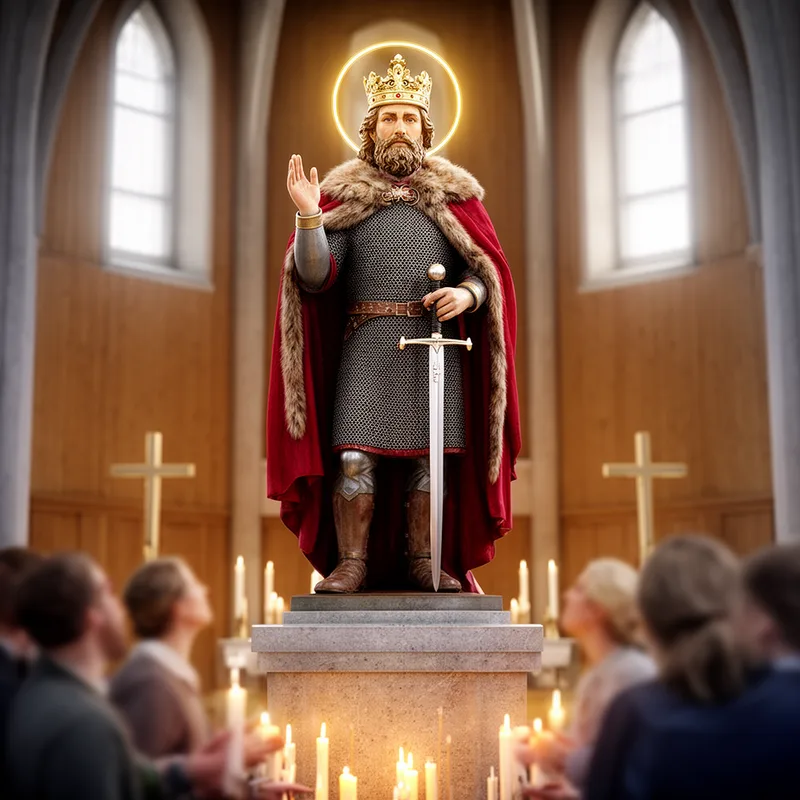
Saint Olaf


 1
8.9
- proper noun
- Every year, people in Trondheim celebrate Saint Olaf's feast day with parades and ceremonies.
Examples
-
King Saint Olaf ruled Norway for many years.
-
Many Norwegian churches are dedicated to Saint Olaf in honor of his legacy.
-
The story of Saint Olaf inspired countless legends throughout Scandinavia.
-
The Saint Olaf festival celebrates his legacy.
-
Every year, people in Trondheim celebrate Saint Olaf's feast day with parades and ceremonies.
-
Many Norwegian churches are dedicated to Saint Olaf in honor of his legacy.
-
The story of Saint Olaf inspired countless legends throughout Scandinavia.
Synonyms

A king of Norway from 995 to 1030 who became the country's patron saint after his death

A Norwegian king from around 1000 who became Norway's patron saint after his death
A king of Norway around 1000 who is the country's patron saint and helped make it Christian

A Norwegian king who is the country's patron saint and is famous for spreading Christianity
Surface Forms
Morphology
saint + Olaf
The form 'Saint Olaf' is partially compositional: a learner who knows 'saint' and recognizes 'Olaf' as a name can infer it refers to a saint called Olaf. However, the specific historical information (that he was King of Norway from 1015–1028 and patron saint) cannot be derived from the constituents alone, and proper names carry culture-specific information that learners must learn by exposure.
Etymology
Saint Olaf comes from a real 11th-century king of Norway who tried to make Norway a Christian country and was killed in battle. People soon called him a saint, so Saint Olaf became the 'patron saint' of Norway and his name is used for churches, places, and yearly festivals.