
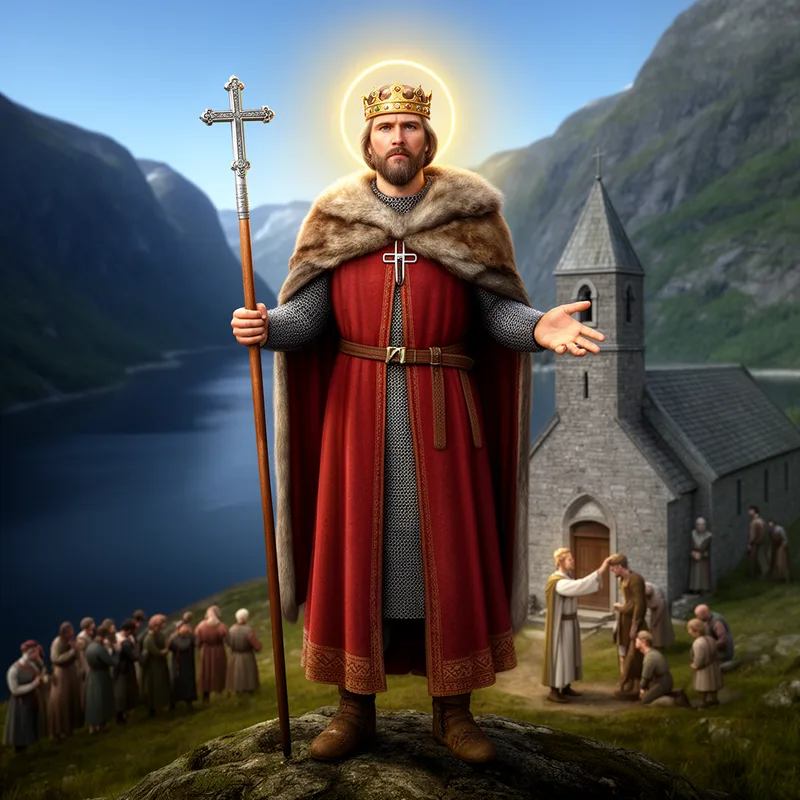
St. Olav
- proper noun
- The Nidaros Cathedral in Trondheim is dedicated to St. Olav.
Examples
-
Many Norwegian towns celebrate the feast day of St. Olav each July.
-
Legends say that St. Olav played a key role in converting Norway to Christianity.
-
Many Norwegians celebrate the feast of St. Olav every July.
-
Did St. Olav really convert Norway to Christianity?
-
Legends say that St. Olav played a key role in converting Norway to Christianity.
-
Many Norwegian towns celebrate the feast day of St. Olav each July.
-
The Nidaros Cathedral in Trondheim is dedicated to St. Olav.
Synonyms



 1
8.9
A king of Norway from 1015 to 1028 who is the country's patron saint

A king of Norway from 995 to 1030 who became the country's patron saint after his death

A Norwegian king from around 1000 who became Norway's patron saint after his death

A Norwegian king who is the country's patron saint and is famous for spreading Christianity
Surface Forms
Morphology
St. + Olav
A learner who knows 'St.' (Saint) and recognises 'Olav' as a name can transparently infer that this refers to a saint called Olav, so the basic referential meaning (a saintly person named Olav) is clear. However, the detailed historical/encyclopedic information that he was King of Norway and its patron saint credited with Christianization cannot be derived from the constituents alone, so the expression is only partially transparent.
Etymology
St. Olav comes from a real king named Olav who lived around the year 1000 and worked to bring Christianity to Norway. After he died in battle, people said miracles happened at his grave, so he was 'made a saint' and became Norway's 'patron saint', which is why towns still celebrate him today.