

Russian thistle
- noun
- /ˈrʌʃən ˈθɪsəl/
- US
- With the spring snowmelt and the first summer rains on the ranch, thousands of Russian thistle seeds began to erupt into the sunlight.
Examples
-
Russian thistle blew across the road, piled up along the fence lines.
-
Through this network, the Frederick lab recently acquired four good candidate pathogens: two on Russian thistle, one on Russian knapweed, and another on common groundsel.
Academic text (2000) -
Russian thistle grows in every state except Florida and Alaska.
Synonyms

A prickly bushy plant like a round tumbleweed that grows in dry areas and damages crops

A prickly bush that breaks off and rolls in the wind across dry land
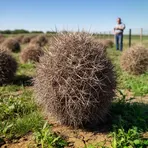
A prickly bushy plant from Europe and Asia that grows wild and causes problems as a weed
How Prickly
- US

 9
6.0
9
6.0

Surface Forms
Morphology
The phrase combines the adjective 'Russian' (relating to Russia) with 'thistle' (a prickly plant), so its meaning as a thistle species associated with Russia or originating there is directly inferable from the parts. This modifier + noun pattern is cross-linguistically common, so a B1 learner who knows both constituents can understand the MWE.
Etymology
Russian thistle gets its name from where it came and how it looks: it came from Russia and is a sharp, bushy thistle-like weed. When it dried it often broke off and rolled across fields as a 'tumbleweed', so today the name means a prickly weed that spreads by rolling.