

Salsola kali tenuifolia
- noun
- Specialized
- Dry regions in the West are often covered with Salsola kali tenuifolia, better known as Russian thistle.
Examples
-
The spread of Salsola kali tenuifolia has created significant problems for local agriculture.
-
In arid landscapes, Salsola kali tenuifolia can often be seen rolling across the ground as tumbleweed.
-
Researchers studied how Salsola kali tenuifolia adapts to different soil types and climates.
-
The Salsola kali tenuifolia is often found in arid regions.
-
Farmers consider Salsola kali tenuifolia a significant pest.
-
Farmers struggle to manage the growth of Salsola kali tenuifolia, which competes with their crops for resources.
-
The presence of Salsola kali tenuifolia in the area indicates poor soil conditions that favor noxious weeds.
Synonyms

 15
6.5
15
6.5

A dry plant that breaks off and rolls in the wind
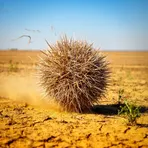
A spiky bush that breaks off and tumbles across dry fields in the wind

A prickly bush that breaks off and rolls in the wind across dry land

A prickly bushy plant from Europe and Asia that grows wild and causes problems as a weed

A bushy plant that grows on sea beaches and salty marshes with prickly leaves
Surface Forms
Morphology
This is a scientific Latin binomial composed of a genus and species epithets, so its everyday meaning (a tumbleweed / noxious Eurasian plant) is specialized botanical knowledge rather than a compositional English phrase. Even if a learner knew that 'Salsola' is a genus and 'kali' roughly denotes a bushy plant, the technical Latin epithet 'tenuifolia' and the taxonomic convention make the overall meaning unpredictable to an average B1 learner.
Etymology
Salsola kali tenuifolia is the Latin name for the prickly bush people call the 'Russian thistle' or 'tumbleweed'. When the plant dries it often breaks off at the base and rolls like a ball across fields, spreading seeds, so people see it as a harmful 'weed'.