

Rhus vernix
- noun
- /rəs ˈvɜrnɪks/
- Specialized
- After brushing against Rhus vernix, she developed an itchy rash on her arm.
Examples
-
Hikers should learn to identify Rhus vernix to avoid painful rashes caused by its oil.
-
The wetlands are home to Rhus vernix, which thrives in the swampy soil.
-
The Rhus vernix plant is often found in wetland areas.
-
Many people are allergic to Rhus vernix and should avoid it.
-
After brushing against Rhus vernix, she developed an itchy rash on her arm.
-
Hikers should learn to identify Rhus vernix to avoid painful rashes caused by its oil.
-
Many people are allergic to Rhus vernix and should avoid it.
Synonyms

 1
8.4
1
8.4

A North American shrub or small tree with white berries and an oil that causes a skin rash

A swamp bush with smooth branches and pale berries whose oil causes a skin rash

A North American swamp shrub with divided leaves and greenish-white berries that produces oil causing skin rashes
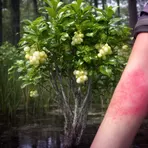
A North American swamp shrub with greenish flowers and poisonous berries and oily parts that cause skin irritation
Surface Forms
Morphology
Rhus + vernix
The form is a Latin binomial (genus + species), so a learner who knows 'Rhus' (sumac) can infer this is a type of sumac/shrub, giving a clear category-level inference. However 'vernix' has no transparent dictionary meaning here and the crucial properties (poisonous, swamp habitat, irritating oil) cannot be derived from the constituents, so the meaning is only partially predictable.
Etymology
Rhus vernix may come from old words: Rhus meaning sumac and vernix meaning a sticky, shiny coating. Because the plant makes an 'oily sap' that sticks to skin and causes a painful rash, the name helps you remember it is the 'poison sumac' to avoid.