

Toxicodendron vernix
- noun
- /ˌtɒkɪˈkoʊdɛndrən ˈvɜrnɪks/
- Specialized
- Many people develop a rash after coming into contact with Toxicodendron vernix in wetland areas.
Examples
-
Botanists studied Toxicodendron vernix to better understand the chemical composition of its irritating oil.
-
The Toxicodendron vernix plant is often found in wetland areas.
-
Toxicodendron vernix has distinctive smooth branches and clusters of pale berries.
-
Many hikers mistakenly touch Toxicodendron vernix without realizing its dangers.
-
Many people develop a rash after coming into contact with Toxicodendron vernix in wetland areas.
-
Botanists studied Toxicodendron vernix to better understand the chemical composition of its irritating oil.
-
Toxicodendron vernix has distinctive smooth branches and clusters of pale berries.
Synonyms

 1
8.4
1
8.4

A North American shrub or small tree with white berries and an oil that causes a skin rash

A shrub also called poison sumac that grows in swamps and makes an oil causing itchy skin rashes

A North American swamp shrub with divided leaves and greenish-white berries that produces oil causing skin rashes
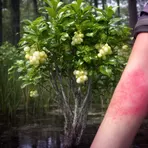
A North American swamp shrub with greenish flowers and poisonous berries and oily parts that cause skin irritation
Surface Forms
Morphology
Toxicodendron + vernix
This is a Latin binomial (scientific name) rather than a composition in everyday English: 'Toxicodendron' is a specialized genus name and 'vernix' is not a common English word, so a B1 learner who knows ordinary English vocabulary would not be able to derive the meaning 'poison sumac' from the parts. Taxonomic names are language-specific and non-compositional for typical learners, making the expression unintelligible without prior exposure or botanical knowledge.
Etymology
Toxicodendron vernix is the scientific name for 'poison sumac'. It was given because the plant makes an oily juice that often causes a skin 'rash', so the name serves as a warning that touching it can irritate your skin.