

Prussian asparagus
- noun
- UK
- The tender shoots of Prussian asparagus are prized in gourmet cuisine for their delicate flavor.
Examples
-
She sautéed Prussian asparagus with garlic and lemon for a simple side dish.
-
I found some fresh Prussian asparagus at the farmer's market.
-
During the spring, locals gather Prussian asparagus from the wild as a seasonal delicacy.
-
Have you ever tried Prussian asparagus in a salad?
-
During the spring, locals gather Prussian asparagus from the wild as a seasonal delicacy.
-
The tender shoots of Prussian asparagus are prized in gourmet cuisine for their delicate flavor.
-
She sautéed Prussian asparagus with garlic and lemon for a simple side dish.
Synonyms

 15
9.1
15
9.1

A plant with white, star-shaped flowers that grows back each year
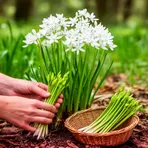
A plant with white star-shaped flowers whose young shoots people eat

A plant with young shoots like asparagus that people eat in spring
Surface Forms
Morphology
The phrase is a straightforward adjective+noun combination where 'Prussian' indicates origin or association and 'asparagus' names an edible plant; a B1 learner who knows both words would infer it refers to an asparagus (or asparagus-like) variety associated with Prussia. This follows normal compositional patterns in English (type/origin + noun) and is therefore immediately interpretable without specialized botanical knowledge.
Etymology
Prussian asparagus got its name because its young shoots look like small asparagus and people in the region once called Prussia gathered them in spring to eat. So the name tells us it is an edible wild plant with shoots used like 'asparagus'.