
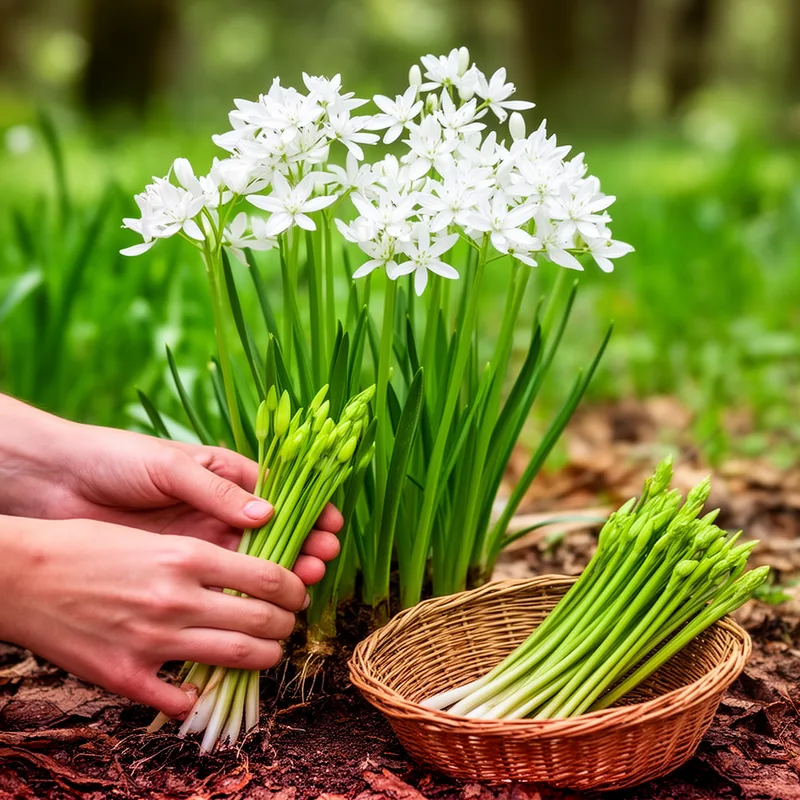
Ornithogalum pyrenaicum
- noun
- Specialized
- The young shoots of Ornithogalum pyrenaicum are often harvested and eaten as a delicacy.
Examples
-
You can find Ornithogalum pyrenaicum growing wild in woodlands across parts of Western Europe.
-
Gardeners sometimes cultivate Ornithogalum pyrenaicum for its attractive flowers and edible stems.
-
The Ornithogalum pyrenaicum is often found in grassy meadows.
-
Have you ever tried cooking with Ornithogalum pyrenaicum?
-
The young shoots of Ornithogalum pyrenaicum are often harvested and eaten as a delicacy.
-
Gardeners sometimes cultivate Ornithogalum pyrenaicum for its attractive flowers and edible stems.
-
Have you ever tried cooking with Ornithogalum pyrenaicum?
Synonyms
A wild plant with thin tender shoots that you eat like a vegetable

A plant with young shoots like asparagus that people eat in spring
Surface Forms
Morphology
Ornithogalum + pyrenaicum
This is a Latin binomial (scientific name) where the second element 'pyrenaicum' is not a normal English word and is absent from the provided dictionary entry, so a B1 learner who knows the genus label would at best infer it is a plant but would not be able to derive the species-specific meaning (native to Europe; edible young shoots). Scientific names are conventionally arbitrary labels rather than compositional English phrases, so the overall meaning is not predictable from the parts for an average learner.
Etymology
Ornithogalum pyrenaicum may come from old Greek parts ornitho meaning 'bird' and galum meaning 'milk', a picture like 'bird's milk' that points to its bright white, star-shaped flowers. The second part pyrenaicum says it is 'from the Pyrenees', so the name helps you remember a white-flowered plant from that region whose young shoots are edible.

