
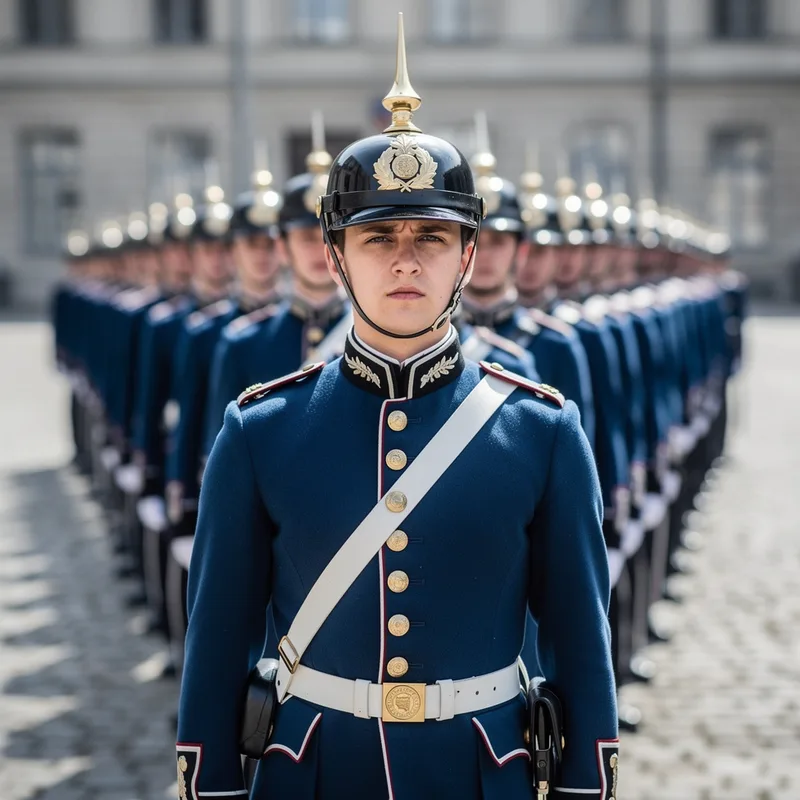
Prussian
 10
8.2
10
8.2

- adjective
- /ˈprʌʃən/
- In 1870, after the declaration of the Franco-Prussian War, he was appointed as surgeon to the army.
- Franco-Prussian
- Prussian War
- Prussian State
Loading YouTube…
Watch on YouTubeAnd he later presented Schwarzschild's work at the Prussian Academy of Science.
- And he later presented Schwarzschild's work at the Prussian Academy of Science.
- Frederick the Great is a monarch who and and at that time the the Prussian monarchs are kind of absolute monarchs.
Examples
-
Prussian troops have been sighted on the road, sire.
-
The Bavarian lion, weeping as usual, is chained to a Prussian sentry box with a smartly uniformed Prussian on guard.
Academic text (2008) -
How is our fine Prussian officer this evening?
-
Sounds like a Prussian plot to try to kill us, sir.
-
I'll show you how a Prussian officer can fight.
-
The Prussian army turned and fled.
-
The Prussian service was considerably worse than the English.
-
And he later presented Schwarzschild's work at the Prussian Academy of Science.
-
In the West, especially beginning in the Prussian Army, the leadership was largely in the hands of the aristocrats.
Academic text (2000) -
The Prussian culture was known for its emphasis on discipline and efficiency.
Compounds
 2
8.9
2
8.9
A war between France and Prussia in 1870–1871 that united the German states into one country



Surface Forms
Morphology
Etymology
Prussian comes from the place name Prussia and the ending -ian, which means 'from'. Prussia was a region by the Baltic Sea long ago, so Prussian describes things or people 'from Prussia' and often refers to the strict, orderly style linked to that place.