
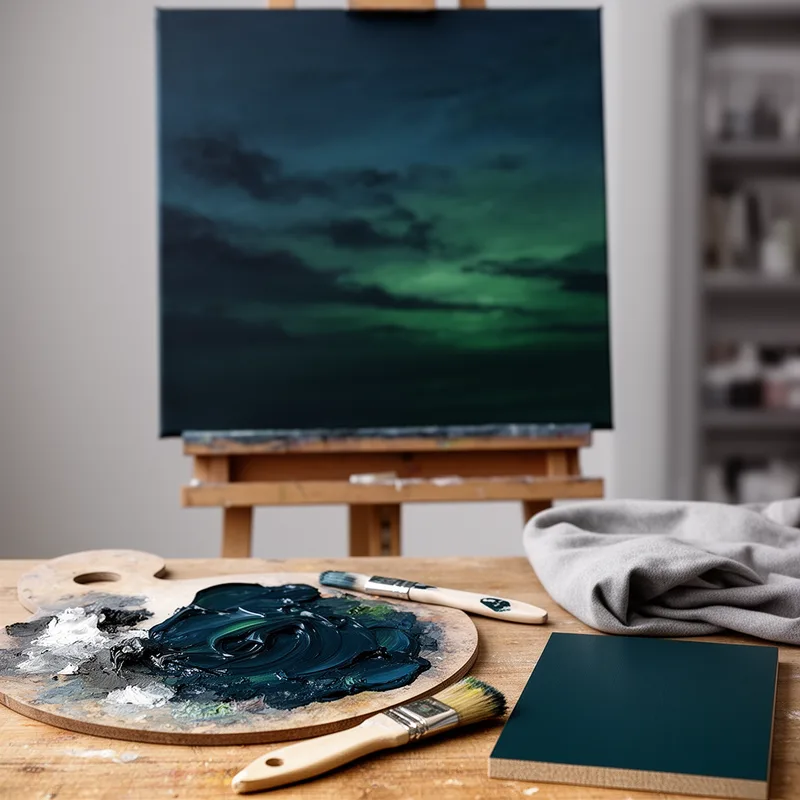
Prussian blue
 1
7.4
1
7.4

- noun
- /ˈprʌʃən blu/
- To create a vibrant landscape, she layered Prussian blue with lighter hues of green.
- Prussian blue and umber
- Prussian blue and vermilion
- Prussian blue pigment
Examples
-
Here, a large part of the surface is obscured by Prussian blue pigment that was applied after collection in Benin.
Academic text (2003) -
In another plaque (Fig. 5), Prussian blue pigment, meant to replicate copper corrosion, obscures much of the surface.
Academic text (2003) -
I'm going to take some Prussian blue and some black.
-
It's Prussian blue.
-
And this is it, medical grade Prussian blue pigment and radiation remover.
-
An early afternoon sky: at the zenith a Prussian blue, breaking off into laundry blue, the color that houses are plastered throughout the Levant.
Fiction book (1993) -
Compared to previous Blues, Prussian blue was more vivid, had greater tonal range and most importantly, didn't fade.
-
Two glistening eyes of a color somewhere between the special glows of cobalt and Prussian blue announced an unsatisfied sensuality.
Fiction book (1992) -
The color Prussian blue, for example, was rendered from blood residue in the eighteenth century, later from ammonia and charcoal, then from sugar-beet molasses and natural gas.
Academic text (1998) -
The artist used Prussian blue to give depth to the ocean in her painting.
Synonyms
 6
1.8
6
1.8
A color that is a mix of blue and green


 1
2.5
1
2.5
A blue color with a little green in it
 1
1.6
1
1.6
A color that is a mix of blue and green

A color that is a mix of blue and green
How Dark

Surface Forms
Morphology
The phrase combines 'Prussian' (of or associated with Prussia) with 'blue', so a learner who knows both words would naturally infer it names a kind of blue associated with Prussia. While the precise hue or pigment history (deep, slightly greenish) may require exposure, the basic sense 'a type of blue color' is transparently derivable from the constituents.
Etymology
The color Prussian blue may come from early 1700s Prussia, a German area long ago, where a maker accidentally mixed iron with another chemical and made a very deep blue. That's why the name Prussian blue now means a deep, greenish 'blue' color used in paint and art.