
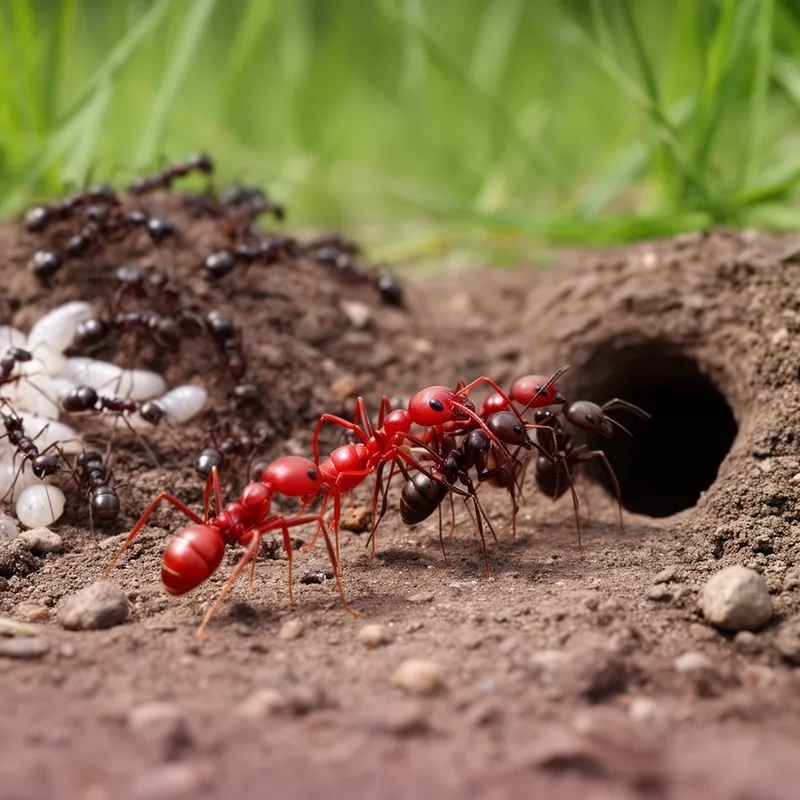
Polyergus rufescens
- noun
- Specialized
- The Polyergus rufescens ant is known for enslaving other ant species to perform tasks within its colony.
Examples
-
The colony of Polyergus rufescens invaded a neighboring nest to capture new workers.
-
The Polyergus rufescens is often referred to as the slave-making ant.
-
Researchers observed that Polyergus rufescens relies on other ant species to maintain its colony.
-
The distinctive reddish color of Polyergus rufescens makes it easy to identify in the field.
-
Have you ever seen a Polyergus rufescens in the wild?
-
In the forest, a colony of Polyergus rufescens was observed capturing workers from a smaller nest.
-
The small reddish Polyergus rufescens ants can be seen directing their enslaved workers to gather food.
Synonyms

A small reddish ant that raids other ant nests and uses captured workers for all tasks

An ant that enters other ant nests and takes young ants to raise as workers
An ant that attacks other ant nests and takes their young to raise as workers in its own nest
Surface Forms
Morphology
Polyergus + rufescens
This is a taxonomic binomial combining a genus name (Polyergus, which signals the slave-making ant group) with a Latin species epithet; if a learner knew that 'rufescens' means 'reddish' the combined meaning (a reddish Polyergus ant) would be derivable. However, the species epithet is Latin and not in the provided dictionary entry (and such Latin epithets are typically unknown to B1 learners), and the formal scientific naming pattern is not a standard everyday English compositional pattern, so the meaning is only partially predictable.
Etymology
Polyergus rufescens comes from old Greek and Latin words: Polyergus combines Greek 'poly' meaning 'many' and 'ergon' meaning 'work', and rufescens is Latin for 'reddish'. The ant is red and it depends on many workers taken from other nests, so the name points to both its colour and its behaviour.

