
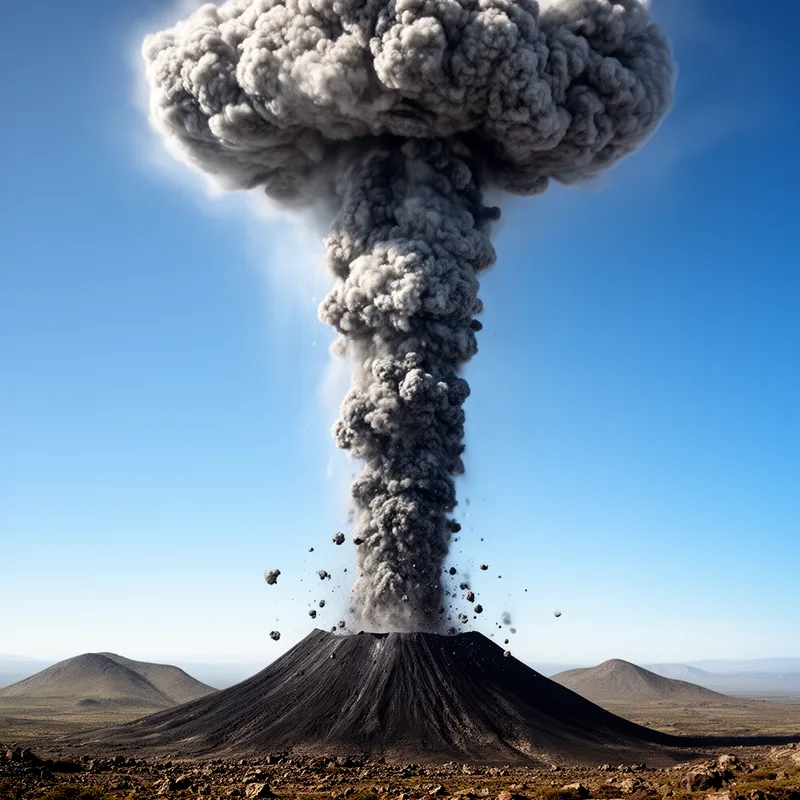
Plinian eruption
- noun
- /ˈplɪniən ɪˈrʌpʃən/
- Specialized
- The Hatepe eruption was the most violent Plinian eruption in recent history.
Examples
-
The explosion of Mount St. Helens in 1980 was classified as a Plinian eruption due to its huge ash cloud.
-
Scientists studied the impact of the Plinian eruption that occurred at Mount Vesuvius in 79 AD.
-
During a Plinian eruption, ash and gas can reach heights of several miles into the atmosphere.
Synonyms

 73
3.9
73
3.9

A sudden violent burst of lava and ash from a volcano
 14
3.5
14
3.5
A sudden release of hot gas, ash, and melted rock from a volcano
How Explosive

Surface Forms
Morphology
The phrase is compositionally an adjective + noun, so if a learner knows the adjective 'Plinian' (a technical eponym describing a very high, sustained ash/gas column) together with 'eruption', the overall meaning is clear. However, 'Plinian' is a specialist, name-derived term that is not predictable from general vocabulary, so the expression is not fully transparent to a typical B1 learner without prior exposure.
Etymology
Plinian eruption gets its name from the writer Pliny the Younger, who described Mount Vesuvius in AD 79 sending up a tall, straight column of ash that looked like a pine tree. That strong picture is used today to mean an eruption that throws ash 'very high' and is 'very violent'.