

Phytolacca americana
- noun
- /ˌfaɪtəˈlækə əˈmɛrɪkən/
- Specialized
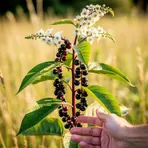
- The berries of Phytolacca americana are a striking reddish-black and are highly toxic to humans.
Examples
-
Some people cook the young shoots of Phytolacca americana as a traditional spring green, known as poke salad.
-
Gardeners are advised to remove Phytolacca americana promptly because its berries can pose a danger to children and pets.
-
The Phytolacca americana grows in many gardens across the United States.
-
Have you ever seen a Phytolacca americana plant in the wild?
-
Gardeners are advised to remove Phytolacca americana promptly because its berries can pose a danger to children and pets.
-
Some people cook the young shoots of Phytolacca americana as a traditional spring green, known as poke salad.
-
The berries of Phytolacca americana are a striking reddish-black and are highly toxic to humans.
Synonyms
 1
9.9
1
9.9

A tall wild plant with white flowers and poisonous berries


 1
9.9
1
9.9
A tall wild plant with dark purple berries that are poisonous if eaten

A tall wild plant with white flowers whose young shoots you can eat but whose berries and roots are poisonous

A tall wild plant with small white flowers whose young shoots people eat but whose berries and roots are poisonous

A tall American plant with white flowers whose small dark fruits and roots are poisonous but young stems are edible
Surface Forms
Morphology
Phytolacca + americana
This is a Latin binomial: 'Phytolacca' names the plant genus and 'americana' signals ‘of America’, so a learner who knows both constituents can infer it denotes an American species of Phytolacca (i.e. a plant). However, the detailed botanical properties in the dictionary definition (tall, coarse perennial; edible stems but poisonous berries/roots) are specialized information not predictable from the parts alone, making the transparency only partial.
Etymology
Phytolacca americana is a scientific name: Phytolacca may come from words for a 'plant' that gave a 'dark dye' from its shiny berries, and americana simply means 'from America'. So the name paints a simple picture of a North American plant with dark, shiny but 'poisonous' berries.