

pigeon berry
- noun
- US
- Early settlers sometimes ate the young stems of pigeon berry as a vegetable.
Examples
-
Children are warned not to eat the pigeon berry because of its poisonous properties.
-
The garden was bordered by a thick stand of pigeon berry, its berries glistening in the sun.
-
The pigeon berry plant grows near the river.
-
I found some pigeon berries in the garden.
-
Children are warned not to eat the pigeon berry because its berries are poisonous.
-
Early settlers sometimes ate the young stems of pigeon berry as a vegetable, but the berries should be avoided.
-
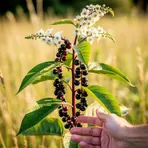
The pigeon berry plant has beautiful white flowers, but its blackish-red berries are toxic.
Synonyms
 1
9.9
1
9.9

A tall wild plant with white flowers and poisonous berries

A tall wild plant with white flowers whose young shoots you can eat but whose berries and roots are poisonous

A tall wild plant with small white flowers whose young shoots people eat but whose berries and roots are poisonous
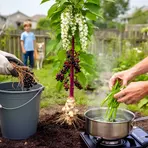
A tall North American plant with white flowers whose young shoots people cook but whose berries and roots are poisonous
Surface Forms
Morphology
The compound is compositionally built from 'pigeon' + 'berry', so a learner who knows both words would reasonably infer it denotes a kind of berry (likely associated with pigeons), making the basic referent predictable. However, the detailed botanical information (tall coarse perennial, edible stems but poisonous berries/roots) and toxicity cannot be derived from the constituents and the name is a relatively rare regional plant term, so full meaning requires prior exposure.
Etymology
Pigeon berry may come from a simple picture: people saw birds like pigeons eating the small red berries and started calling the plant after the birds. That's why the name means a plant with berries that attract birds, even though the berries can be poisonous to people.