
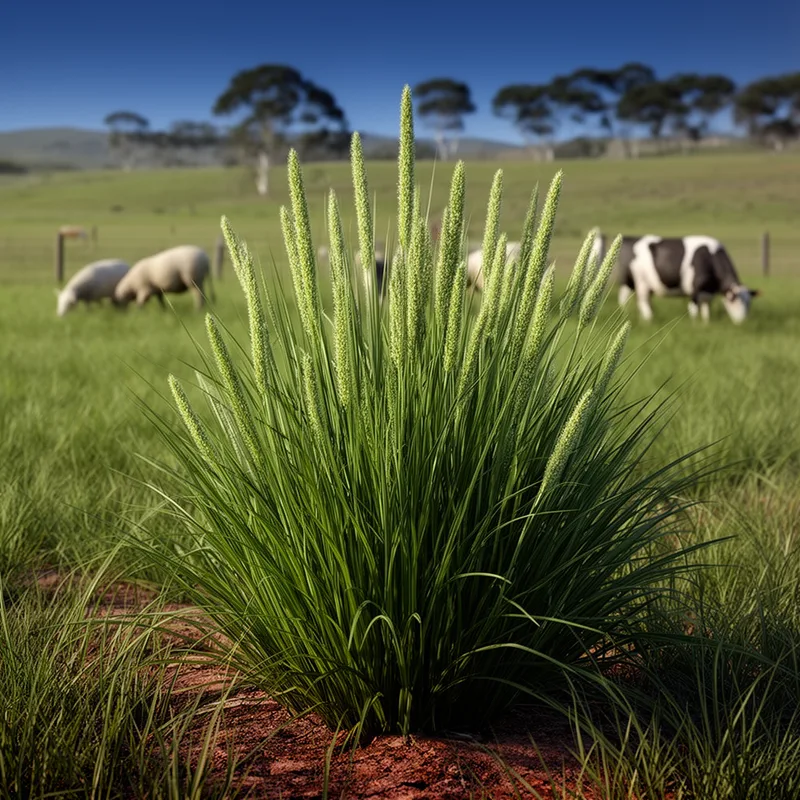
Phalaris tuberosa
- noun
- Australian
- The Phalaris tuberosa is often used as forage for livestock.
Examples
-
Farmers in Australia cultivate Phalaris tuberosa for its high nutritional value.
-
Farmers in southern Australia use Phalaris tuberosa to improve soil conservation on their properties.
-
Phalaris tuberosa is commonly planted in pastures to provide high-quality forage for livestock.
-
Some researchers study the ecological effects of Phalaris tuberosa after its introduction to new regions.
-
Phalaris tuberosa is commonly planted in pastures to provide high-quality forage for livestock.
-
Farmers in Australia cultivate Phalaris tuberosa for its high nutritional value.
-
Many ranchers prefer using Phalaris tuberosa as it promotes healthy growth in their herds.
Synonyms
A tall grass used for grazing animals, often in dry areas

A perennial grass from Australia and South Africa grown for animal feed

A grass from Australia and South Africa that lives many years and is grown for animal feed
Surface Forms
Morphology
Phalaris + tuberosa
The binomial is partially compositional: 'Phalaris' names a genus of grasses and, if the learner knew the Latin-derived adjective 'tuberosa' (tuberous), they could infer a Phalaris species with tuberous characteristics. However, the full dictionary definition (perennial, native range, and use as forage) is not derivable from the constituents and 'tuberosa' is not a standard English word, so the connection is only partial.
Etymology
Phalaris tuberosa is a plant name that points to how the grass looks: Phalaris is the grass group and tuberosa means 'having tubers' or 'small potato-like roots'. So the name gives a simple picture to remember that it is a perennial grass with little underground root bulbs often grown as food for animals.

