
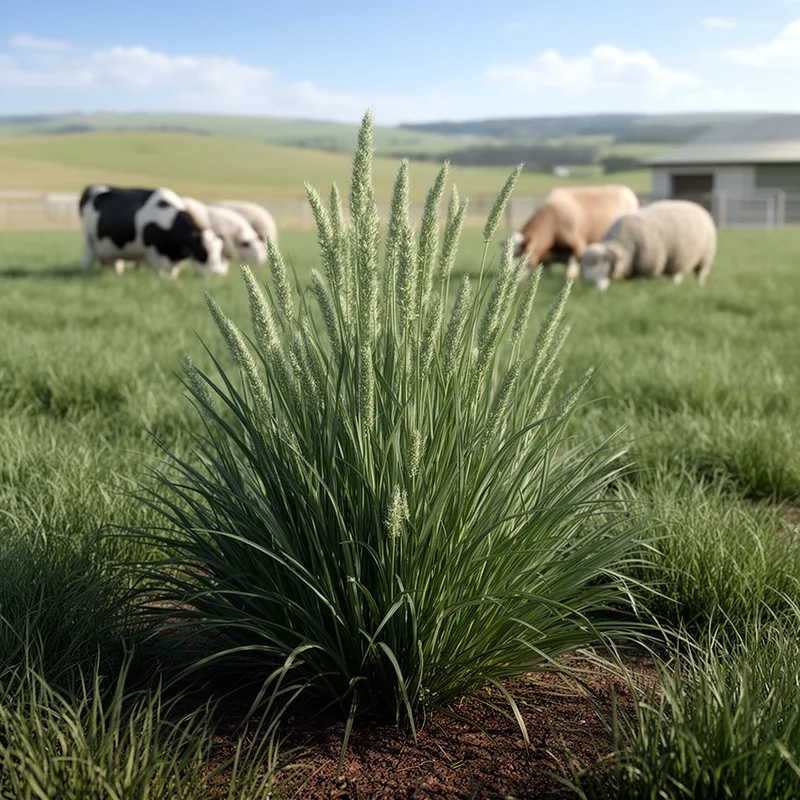
Phalaris aquatica
- noun
- Australian
- Farmers in California frequently harvest Phalaris aquatica for use as silage and hay.
Examples
-
Research has shown that Phalaris aquatica adapts well to a variety of climates and soil types.
-
Farmers often cultivate Phalaris aquatica for their livestock.
-
Phalaris aquatica is often planted in pastures to provide high-quality feed for grazing animals.
-
Have you ever seen Phalaris aquatica growing in the wild?
-
Phalaris aquatica is often planted in pastures to provide high-quality feed for grazing animals.
-
Farmers in California frequently harvest Phalaris aquatica for use as silage and hay.
-
Research has shown that Phalaris aquatica adapts well to a variety of climates and soil types.
Synonyms

A grass from Australia and South Africa that lives for several years and is grown for animal feed

A perennial grass from Australia and South Africa grown for animal feed

A tall grass used for grazing animals, often in dry areas
Surface Forms
Morphology
Phalaris + aquatica
The binomial name is partly compositional: 'Phalaris' is given as a type of grass and 'aquatica' transparently evokes 'aquatic' (water‑related), so a learner who knew both parts could infer it is a grass associated with water. However, 'aquatica' is not dictionary‑defined here and Latin species names and taxonomic conventions are not everyday knowledge for B1 learners, so the specific referent and nuances are not fully predictable without exposure.
Etymology
Phalaris aquatica may come from an old Greek word Phalaris meaning a 'tuft' and the Latin word aquatica meaning 'of water', because these grasses have tight, tuft-like flower heads and often grow in damp places. So the name paints a simple picture — a tufted grass that likes wet ground — which helps you remember it is a grass often grown for animal feed.

