

Peruvian bark
- noun
- /pəˈruːviən bɑrk/
- Archaic
 :
corteza peruana
:
corteza peruana
- She served as a nurse during the yellow fever epidemic of 1853 and advocated the use of Peruvian bark.
Examples
-
So it was Hahnemann, in the very early days of homeopathy, who proposed that Peruvian bark (which contains quinine) might be effective for treating people with malaria.
Blog text (27) -
In the 17th century, physicians recommended Peruvian bark as a treatment for fevers caused by malaria.
-
Due to its high content of quinine, Peruvian bark has been used for centuries to alleviate symptoms of malaria.
-
Many herbalists believe Peruvian bark can help with various ailments due to its medicinal properties.
Synonyms
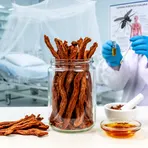
Dried bark from a tree used to make medicine for malaria
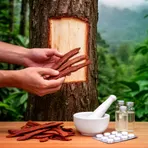
The bark of South American trees that people use to make medicine for malaria

Bark from a tree used to make medicine for malaria
Surface Forms
Morphology
Peruvian bark is a straightforward adjective + noun combination meaning the bark that comes from Peru; a B1 learner who knows 'Peruvian' and 'bark' will readily interpret it as bark originating in Peru. While the specific historical/medicinal reference to cinchona and quinine is specialized knowledge, the compositional referent is transparent and follows common cross-linguistic patterns of origin + noun.
Etymology
Peruvian bark comes from the bark of a South American tree and the word Peruvian shows where it was first used. Local people used it to treat 'fevers', and later doctors took 'quinine' from the bark, so the phrase means the tree bark used as a medicine.

