

Old World robin
- noun
- UK
- The Old World robin is often seen hopping around gardens in search of worms.
Examples
-
Unlike its American namesake, the Old World robin is much smaller and found throughout Europe.
-
Her favorite bird is the Old World robin because of its cheerful song and bright breast.
-
The Old World robin sings beautifully in the morning.
-
Have you seen an Old World robin in your garden?
-
Her favorite bird is the Old World robin because of its cheerful song and bright breast.
-
The Old World robin is often seen hopping around gardens in search of worms.
-
Unlike its American namesake, the Old World robin is much smaller and found throughout Europe.
Synonyms
 9
1.0
9
1.0

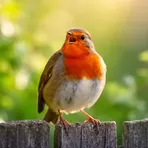
A small bird that sings with a red or orange breast found in Europe and Asia
 1
8.1
1
8.1
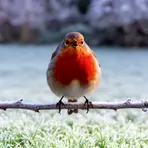
A small songbird with a red chest, like the European robin


 1
4.1
1
4.1
A small brown bird with a bright red breast often seen in gardens and woods

A small bird with a red-orange chest often seen in European gardens

A small bird that sings with a red breast often seen in gardens
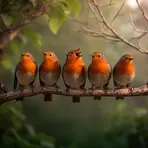
A group of small birds like the European robin that live in Europe and nearby areas
Surface Forms
Morphology
The phrase is compositionally built from 'Old World' + 'robin': 'robin' identifies the bird and 'Old World' signals geographic origin (the Eurasian/Old World range). However, 'Old World' as a conventional geopolitical/biodiversity term may be unfamiliar to a B1 learner, so the precise sense (the specific Eurasian species as opposed to New World robins) is not fully predictable without background knowledge.
Etymology
Old World robin uses Old World to show the bird comes from Europe and Asia, and robin is the small, friendly bird with a red breast. So Old World robin means the small songbird from Europe and Asia with a bright red chest, not the larger American robin.