

Erithacus rubecola
- noun
- Specialized
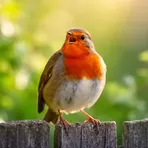
- The Erithacus rubecola is easily recognized by its bright orange-red chest.
Examples
-
Many British gardens are frequently visited by the Erithacus rubecola during winter.
-
Ornithologists often study the migration patterns of Erithacus rubecola across Europe.
-
Look at that Erithacus rubecola!
-
The Erithacus rubecola is often seen in gardens during spring.
-
Many British gardens are frequently visited by the Erithacus rubecola during winter.
-
Ornithologists often study the migration patterns of Erithacus rubecola across Europe.
-
The Erithacus rubecola is easily recognized by its bright orange-red chest.
Synonyms
 9
1.0
9
1.0

A small bird that sings with a red or orange breast found in Europe and Asia
 1
8.1
1
8.1
A small songbird with a red chest, like the European robin


 1
4.1
1
4.1
A small brown bird with a bright red breast often seen in gardens and woods

A small European bird with a red breast that sings and lives in gardens and woods

A small bird that sings with a red breast often seen in gardens
Surface Forms
Morphology
Erithacus + rubecola
This is a Latin binomial (scientific name) rather than a normal English phrase; its parts are taxonomic labels, not compositional English vocabulary, and the second element is not a standard English word. Even if a learner recognized 'Erithacus' as a genus, the overall meaning 'European robin' is specialist biological knowledge rather than a predictable combination of constituent meanings, so it would not be derivable by an average B1 learner.
Etymology
Erithacus rubecola may come from old words that picture a small robin with a red breast: Erithacus points to a little 'robin' and rubecola comes from Latin parts meaning 'red' and 'dweller'. That's why the name fits the small European robin with a bright orange-red chest today.