
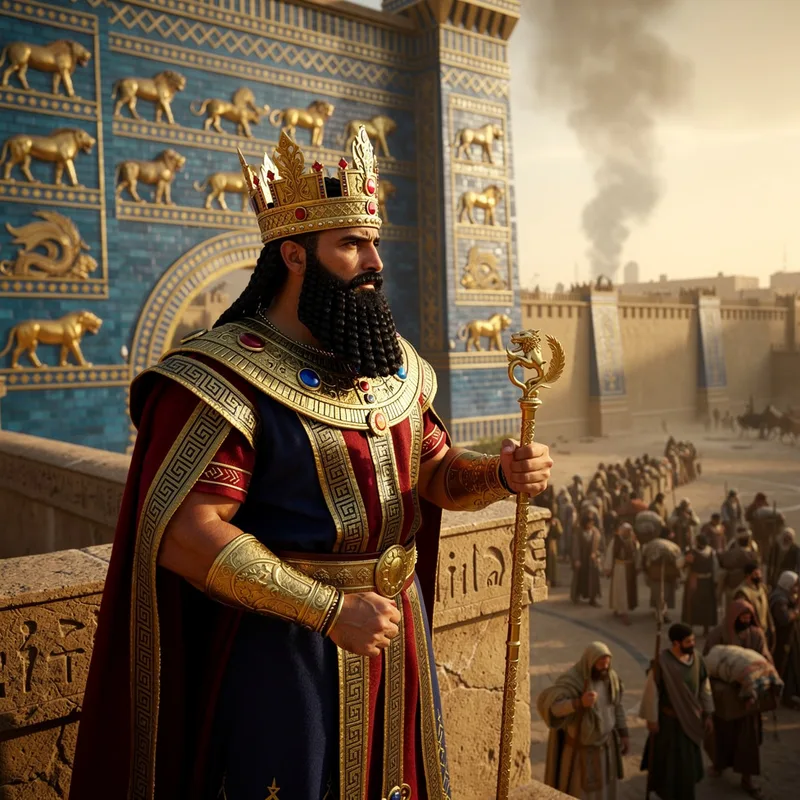
Nebuchadnezzar
 8
9.9

- proper noun
- /ˌnɛbʊkədˈnɛzər/
- Nebuchadnezzar II is said to have built them around 600.
- Nebuchadnezzar II
- King Nebuchadnezzar
- Nebuchadnezzar of Babylon
Loading YouTube…
Watch on YouTubeThe Nebuchadnezzar and the Babylonian army destroys the first Solomon's temple.
- The Nebuchadnezzar and the Babylonian army destroys the first Solomon's temple.
Examples
-
Not since the Babylonian king Nebuchadnezzar destroyed Solomon's temple had such a thing happened.
Fiction book (1998) -
He cites the example of the three youths from the book of Daniel who were tossed into the fiery furnace by King Nebuchadnezzar because they refused to worship him.
-
I thought about that old king, Nebuchadnezzar.
Fiction book (1991) -
Finally, King Nebuchadnezzar set up a statue that had these dimensions:
Blog text (26) -
Nebuchadnezzar later took Israel into captivity and imposed his own form of law and order.
Academic text (1991) -
Daniel, the young Hebrew who was taken into Babylonian captivity, served in the court of King Nebuchadnezzar and then King Belshazzar.
Blog text (8) -
According to the Midrash, Vashti was the great-granddaughter of King Nebuchadnezzar II of Babylon, the destroyer of Jerusalem.
Academic text (2010) -
As Reau has noted, the Temple of Solomon refers to the triumph of the Church; the Temple, destroyed by Nebuchadnezzar, was rebuilt by the Israelites after their triumphant return to Jerusalem.
Academic text (1991) -
So even while Tisha B'Av contains the seed of our longing for the Messiah, there was no Messiah when the armies of Nebuchadnezzar or Titus breached the walls of Jerusalem.
Academic text (1995) -
King Nebuchadnezzar conquered Jerusalem and took its people into exile in Babylon.
Synonyms

 1
9.9
A king of Babylon who destroys Jerusalem and sends the Israelites into exile
 1
9.9
A Babylonian king around 600 BC who destroyed Jerusalem and sent many Israelites to Babylon
The king of Babylon who conquered Jerusalem and sent the Israelites to Babylonia
Surface Forms
Etymology
Nebuchadnezzar comes from the old Babylonian name Nabu-kudurri-usur, which calls on the god Nabu to 'protect my eldest son'. So the name fits a powerful king who wanted the god's protection.