
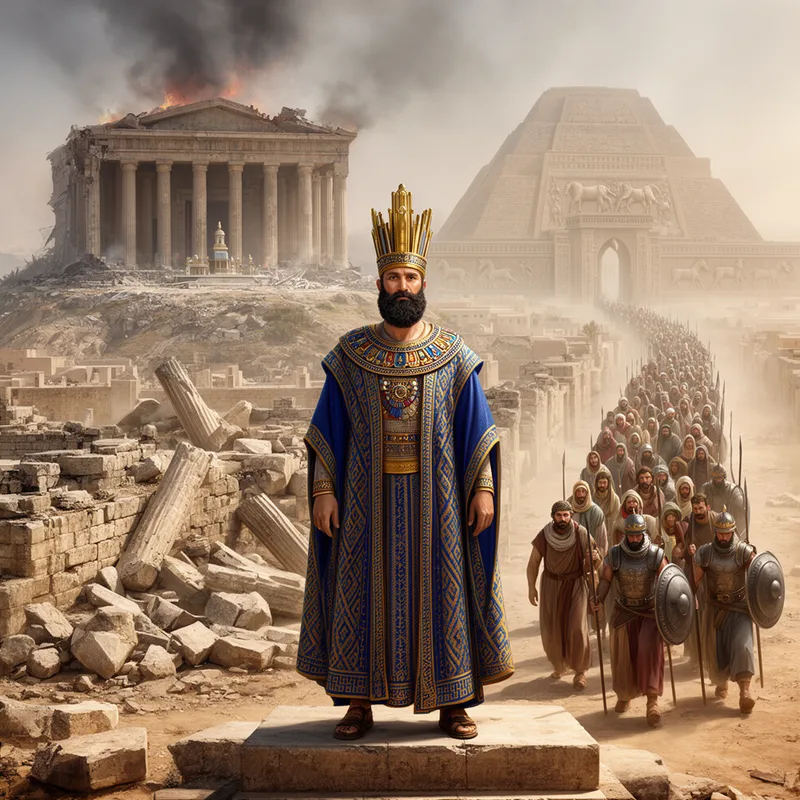
Nebuchadrezzar II
- proper noun
- /ˌnɛbʊkəˈdrɛzər/
- Nebuchadrezzar II ruled over Babylon from approximately 605 to 562 BC.
Examples
-
Nebuchadrezzar II was responsible for the destruction of the First Temple in Jerusalem.
-
King Nebuchadrezzar II ruled Babylon for 43 years.
-
Historians study the reign of Nebuchadrezzar II to understand the history of ancient Babylonia.
-
The story of Nebuchadrezzar II is recounted in many books of the Old Testament.
-
Did Nebuchadrezzar II really destroy Jerusalem?
-
Nebuchadrezzar II was known for his campaigns that included the conquest of Jerusalem.
-
During his reign, Nebuchadrezzar II exiled many Israelites to Babylonia.
Synonyms

 8
9.9

A king of ancient Babylon who destroyed Jerusalem and sent the Israelites to live in Babylonia in the 600s BC


 1
9.9
A king of Babylon who destroys Jerusalem and sends the Israelites into exile
 1
9.9
A Babylonian king around 600 BC who destroyed Jerusalem and sent many Israelites to Babylon
Surface Forms
Morphology
This is a proper name composed of the personal name 'Nebuchadrezzar' plus the ordinal 'II'; a B1 learner who knows the name and the Roman numeral will understand it denotes the second ruler with that name. The construction is fully compositional and follows common cross-linguistic naming conventions (name + ordinal), so the meaning is transparent.
Etymology
Nebuchadrezzar II is a name from old Babylon that includes the god Nabu, and one popular meaning is 'Nabu, protect my son'. So the name was a royal prayer and now it names the powerful king who destroyed Jerusalem and sent the Israelites away to Babylonia.