
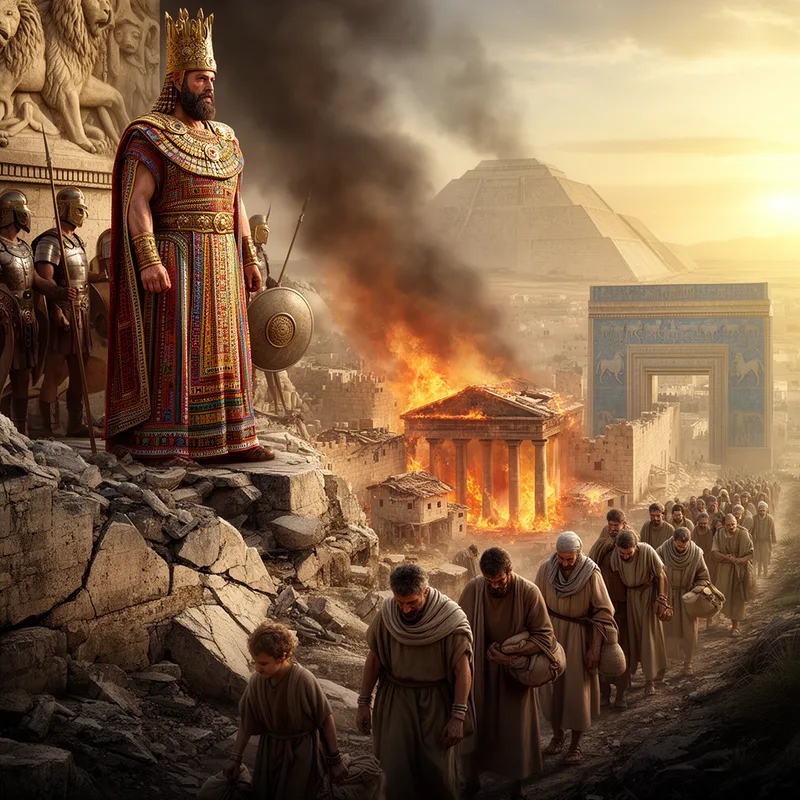
Nebuchadnezzar II


 1
9.9
- proper noun
- /ˌnɛbʊkədˈnɛzər tuː/
- King Nebuchadnezzar II ruled Babylon from 605 to 562 BC.
Examples
-
The Hanging Gardens are sometimes attributed to Nebuchadnezzar II, though their existence remains debated.
-
Historians continue to study the reign of Nebuchadnezzar II for its profound impact on ancient Mesopotamia.
-
The conquest of Jerusalem by Nebuchadnezzar II changed the course of Jewish history.
-
Did Nebuchadnezzar II really destroy Jerusalem?
-
The conquest of Jerusalem by Nebuchadnezzar II changed the course of Jewish history.
-
Historians continue to study the reign of Nebuchadnezzar II for its profound impact on ancient Mesopotamia.
-
King Nebuchadnezzar II ruled Babylon from 605 to 562 BC.
Synonyms
 8
9.9
A king of ancient Babylon who destroyed Jerusalem and sent the Israelites to live in Babylonia in the 600s BC
 1
9.9
A king of Babylon who destroys Jerusalem and sends the Israelites into exile

The king of Babylon who conquered Jerusalem and sent the Israelites to Babylonia
Surface Forms
Morphology
This is a proper name composed of the personal name 'Nebuchadnezzar' plus the ordinal 'II'; a B1 learner who knows the constituents will readily infer it refers to the second Nebuchadnezzar (the ruler). The use of ordinals/Roman numerals to indicate succession is a common, predictable naming convention across languages, so the overall meaning is directly derivable from the parts.
Etymology
Nebuchadnezzar II is the name of a powerful king of ancient Babylon who 'captured' Jerusalem and 'exiled' many Israelites to Babylon. His dramatic actions are remembered in the Bible, so the name brings to mind a ruler who destroyed a city and forced people to leave their homes.