

NMR
 2
7.1
2
7.1

- noun
- /ˌɛn ɛm ˈɑr/
- Specialized
- The NMR technique is essential in determining the molecular structure of complex compounds.
- NMR magnetic
- Nuclear magnetic resonance (NMR)
- NMR resonance
Loading YouTube…
Watch on YouTubeWell, the way it's actually done nowadays is by NMR, right?
- Well, the way it's actually done nowadays is by NMR, right?
- And how many of you guys have seen NMR before in your classes?
Examples
-
Using NMR, researchers can analyze the composition of substances in both chemistry and medical imaging.
-
Other biomedical applications of NMR include vascular flow measurements and the study of cellular metabolism.
Academic text (1993) -
However, it was difficult to separate the NMR contributions coming from the liquid and the solid.
Academic text (1996) -
How does one associate a particular NMR signal with a small localized region in the human body?
Academic text (1993) -
Just this summer, the group reported the solution NMR studies of a structure whose size is 870 kDa.
Academic text (2002) -
Generally speaking, NMR detection is more sensitive the higher the Larmor frequency is in the radio spectrum.
Academic text (1993) -
The Cornell experimenters recognized they needed to use NMR to confirm the transition they had found.
Academic text (1996) -
Nuclear magnetic resonance spectroscopy (NMR) has provided evidence that methylamines accumulate in chronic renal failure.
Academic text (1991) -
27Al MAS-NMR analysis: Figures 7 and 8 display the 27Al MAS-NMR spectra for the geopolymer mortar samples and raw fly ashes.
Academic text (2017) -
Many scientists rely on NMR to gather detailed information about the magnetic properties of atomic nuclei.
Synonyms
 1
6.8
1
6.8
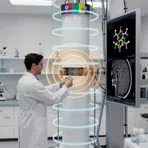
A method that uses strong magnets and radio waves to make images or study molecules

A method using a strong magnet and radio waves to make images of body parts or molecules
Surface Forms
Etymology
NMR stands for Nuclear Magnetic Resonance. The parts mean 'nuclear' = 'center of an atom', 'magnetic' = 'like a magnet', and 'resonance' = 'vibration' or 'echo', so the method 'listens' to tiny magnetic vibrations in atoms to learn a molecule's shape.