
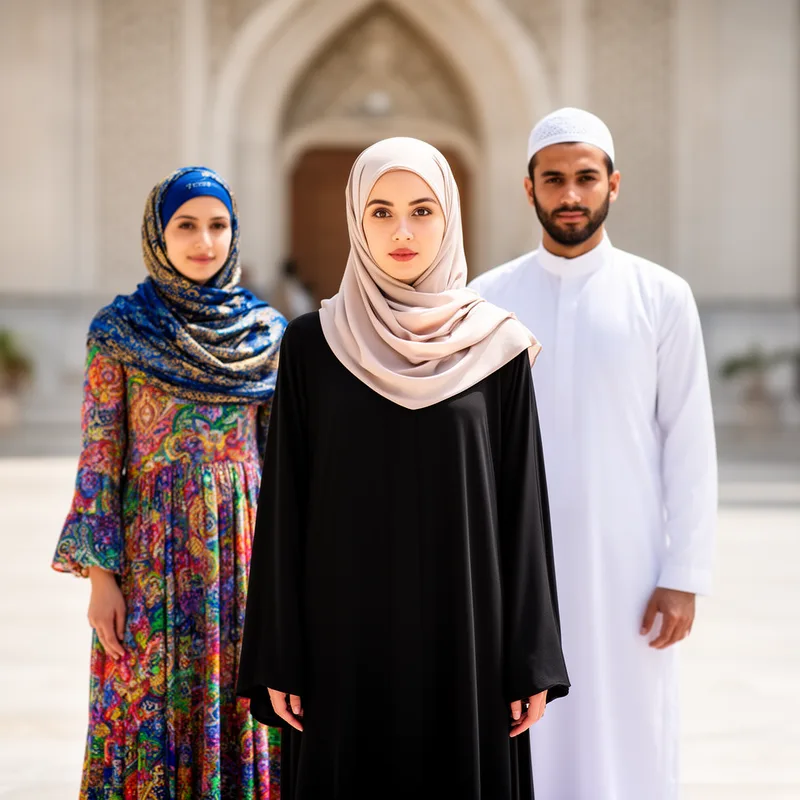
Muslim attire
- noun
- Many women choose to wear Muslim attire as an expression of their faith.
Examples
-
She wore a beautiful Muslim attire to the wedding.
-
The school's dress code is respectful of Muslim attire such as hijabs and long dresses.
-
During the festival, most participants were dressed in traditional Muslim attire.
-
Many women choose to wear Muslim attire for cultural events.
-
At the wedding, many guests wore beautiful Muslim attire, including colorful hijabs and elegant abayas.
-
She decided to wear Muslim attire during the religious celebration to honor her cultural heritage.
-
The market had a variety of Muslim attire available, showcasing traditional styles and patterns from different regions.
Synonyms

 59
3.4
59
3.4

A cloth worn to cover the head and face for religion, ceremony, or privacy
 28
3.7
28
3.7
A head covering that you make by wrapping a long cloth around the head
 18
5.2
18
5.2
A cloth some Muslim women wear to cover their hair and neck for modesty
 10
2.3
10
2.3
A piece of cloth often worn by women on the head for warmth, to cover hair, or for style
 6
7.5
6
7.5
A long loose garment that covers the whole body and face, worn by some Muslim women
 2
9.2
2
9.2
A cloth some Muslim women wear to cover their faces except for the eyes
 2
9.8
2
9.8
A long loose black robe worn by some Muslim women to cover the body in public
 1
9.8
1
9.8
A long shirt worn in South Asia with loose trousers


 1
9.9
1
9.9
Special white clothes and a set of rules Muslims follow during the religious trip to Mecca
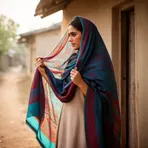
A large cloth women wrap over their head and shoulders

A long loose robe with a hood worn in North Africa

A long loose robe with a hood that people wear in North Africa and the Middle East

A long loose robe that men wear in some Muslim countries

A small cap worn under a turban by Muslim religious elders

A crown with jewels worn on the head at ceremonies in South Asia
How Modest

Surface Forms
Morphology
The meaning is directly compositional: 'Muslim' (pertaining to Islam) modifies 'attire' (clothing), so a learner who knows both words can infer it refers to clothing associated with Muslims. This adjective+noun pattern is cross-linguistically common, making the phrase easily understandable to a B1 learner.
Etymology
Muslim attire comes from the simple picture of clothes that show someone is Muslim: the word Muslim (a follower of Islam) plus attire (clothes). These can be items like a hijab, abaya, or kufi, so the phrase means 'clothing that reflects faith or culture'.