

niqab
 2
9.2
2
9.2

- noun
- /nɪˈkɑb/
- Only one woman removed the niqab to comply with the law and has claimed that she is socializing more.
- wearing a niqab
- niqab ban
Loading YouTube…
Watch on YouTubeThe burqa, the niqab, and to some extent the hijab are liberating.
- The burqa, the niqab, and to some extent the hijab are liberating.
Examples
-
The majority of women surveyed did not find the niqab a hindrance to public social interaction.
Academic text (2018) -
How does wearing a niqab impact your social interactions with the general public?
Academic text (2018) -
One woman, a single mother, removed her niqab out of survival to find a job to provide for her children.
Academic text (2018) -
So I don't know if this is a OK question to ask, but when does the niqab come off?
-
Often, no eye contact is possible; niqab wearers sometimes wear dark glasses so that their eyes cannot be seen.
Academic text (2010) -
Recent estimates suggest that approximately 2,000 women in France wear the niqab or burqa in public.
Academic text (2010) -
The burqa and the niqab are striking symbols for those who wear them and for those who don't.
Academic text (2010) -
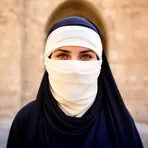
The woman wore a niqab that covered her face, allowing only her eyes to be seen.
-
Many Muslim women choose to wear a niqab as a sign of their faith.
-
In her community, wearing a niqab is viewed as a cultural tradition among some families.
Synonyms
 59
3.4
59
3.4
A cloth worn to cover the head and face for religion, ceremony, or privacy
 1
6.3
1
6.3
A thin cloth worn to partly cover the face, often for religious or cultural reasons

 1
9.9
1
9.9
A cloth veil worn by some Muslim women that covers the face leaving only the eyes visible
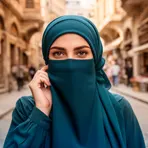
A face veil worn by some Muslim women that leaves the eyes visible
How Covered

Surface Forms
Etymology
Niqab comes from the Arabic word niqāb, which means 'veil' or 'cover'. A helpful way to remember it is to think of a 'mask' that leaves only the 'eyes' visible, which is exactly what a niqab does today.