

Mucuna deeringiana
- noun
- Specialized
- Many farmers in the southern U.S. plant Mucuna deeringiana to enrich their soil.
Examples
-
The hairy pods of Mucuna deeringiana can cause skin irritation if touched.
-
Researchers are studying Mucuna deeringiana for its potential benefits as a cover crop.
-
The Mucuna deeringiana plant thrives in warm climates.
-
Farmers often grow Mucuna deeringiana for its benefits.
-
Many farmers in the southern U.S. plant Mucuna deeringiana to enrich their soil.
-
Researchers are studying Mucuna deeringiana for its potential benefits as a cover crop.
-
Farmers often grow Mucuna deeringiana as a sustainable practice to improve soil health.
Synonyms

A fast-growing vine with purple flowers and hairy pods used as food for animals and to improve soil

A tropical vine grown as a cover crop to improve soil and feed animals

A climbing plant with purple flowers and hairy pods grown to improve soil and feed animals

A climbing plant from Asia with long purple flower clusters and hairy pods used to improve soil and feed animals

A climbing plant people grow to feed animals and improve soil
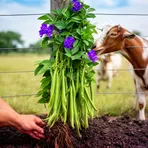
A climbing plant with purple flowers and long hairy pods used to improve soil and feed animals

A woody climbing plant with purple flowers and hairy pods that farmers grow to feed animals and improve soil

A climbing plant with purple flowers and hairy pods grown to enrich soil and feed animals
Surface Forms
Morphology
Mucuna + deeringiana
This is a Latin binomial: knowing 'Mucuna' as a plant genus lets a learner infer that the phrase names a species of Mucuna (so it denotes a plant). However, 'deeringiana' is a specific epithet (a proper-name formation) that does not convey the species' properties, so the detailed sense ('annual woody vine native to Asia...') cannot be predicted from the parts.
Etymology
Mucuna deeringiana is a plant name made of two parts: Mucuna comes from a native word for the plant's itchy, hairy pods, and deeringiana shows it was named after a person called Deering. So the name is like 'Deering's mucuna', which helps you remember the vine with hairy pods that can make your skin itch.

