

Middle East
 238
2.8
238
2.8

- proper noun
- /ˈmɪdəl iːst/
- The Middle East is rich in history, with ancient civilizations dating back thousands of years.
- Middle East peace
- Middle East policy
- countries in the Middle East
Loading YouTube…
Watch on YouTubeThe shape of tomorrow's Middle East hinges on what happens next.
- The shape of tomorrow's Middle East hinges on what happens next.
- Trump's corruption tour in the Middle East is just swinging away.
- If we succeed in the Middle East, our alliances are also crucial.
- Are you optimistic about the Middle East, about the Arab speaking Middle East?
- And here, here's Middle East peace right here.
- You just got back from the Middle East, from Abu Dhabi.
- So the question now is, is our deterrence in the Middle East too weak?
- They don't want a big, huge Middle East war.
- So I got on the plane, fly to the Middle East and he says, here's the story.
- So I am working with a company in the Middle East right now.
- They said the world will end someday in the Middle East.
- We had Asia, Africa and Middle East and Australia.
- There is no hope for the Middle East, for our country.
- But if they're brown people from the Middle East or Asia, not so much.
Examples
-
He spent much of his life in the Middle East and he knows what's going on.
-
Unfortunately, the Obama administration did not appear to have a real grasp of the Middle East reality.
Academic text (2015) -
There was a single death of note in the Middle East this week.
-
That would keep the Middle East pretty calm.
-
The trouble in the Middle East was going to get worse.
Fiction book (1999) -
Tired of the standard press coverage of the Middle East, they had come to see another side of things.
Academic text (2008) -
The biggest risk in the Middle East this year is Iran.
-
Support for artistic freedom in the Middle East is often based on this view.
Academic text (2008) -
U.S. opinion on the Middle East is not monolithic, nor is it frozen in time.
Academic text (2008) -
The shape of tomorrow's Middle East hinges on what happens next.
Synonyms
 53
3.7
53
3.7
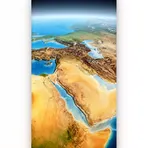
A region around the eastern Mediterranean including countries from Turkey to Iran
 7
4.3
7
4.3
A region around the eastern Mediterranean that includes parts of Southwest Asia and Egypt
Surface Forms
Morphology
The phrase is a direct compositional combination of 'middle' (central) and 'east' (eastern region), so a B1 learner who knows both words can reasonably infer it denotes the central part of the East; although precise political boundaries are not predictable, the general regional meaning is transparent. This construction is cross-linguistically common (e.g., Spanish 'Medio Oriente', French 'Moyen-Orient'), supporting immediate comprehension from the constituents.
Etymology
Middle East comes from a European point of view. People once called lands closer to Europe the 'Near East' and lands far away like China the 'Far East', so the area in between was called the 'Middle East', and that is why the name now refers to the region from Egypt and Turkey to Iran.