

Manihot dulcis
- noun
- Specialized
- The roots of Manihot dulcis are harvested for use in traditional South American dishes.
Examples
-
Farmers grow Manihot dulcis as a valuable source of livestock fodder and staple food.
-
Farmers in Brazil cultivate Manihot dulcis for its nutritious roots.
-
Research focuses on improving the yield and nutritional value of Manihot dulcis for both people and animals.
-
The Manihot dulcis plant thrives in warm climates.
-
Farmers grow Manihot dulcis as a valuable source of livestock fodder and staple food.
-
Research focuses on improving the yield and nutritional value of Manihot dulcis for both people and animals.
-
The roots of Manihot dulcis are harvested for use in traditional South American dishes.
Synonyms

 1
7.5
1
7.5

A tropical plant with thick starchy roots used for food


 1
7.5
1
7.5
A tropical plant with a large starchy root used for food and to make flour

A cassava with roots that need less cooking and leaves used to feed animals
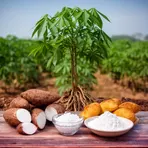
A plant with thick edible roots used to make food and products like tapioca

A tropical plant with large starchy roots used for food and to make tapioca

A tropical plant with long edible roots that people use to make tapioca and flour
Surface Forms
Morphology
Manihot + dulcis
As a Latin binomial the name signals a plant genus (Manihot) with an adjectival descriptor (dulcis = 'sweet'), so a learner who knows the constituents can infer it is a sweet species/variety of Manihot (i.e., a plant). However, specific pragmatic information in the definition (roots used as a vegetable, foliage as livestock feed) is not derivable from the name alone and many learners will not know Latin descriptors, so the full meaning is only partially predictable.
Etymology
Manihot dulcis combines the local crop name 'manioc', shown in Manihot, and the Latin word dulcis meaning 'sweet'. So the name paints a clear picture of a 'sweet manioc' root that people eat and farmers also use to feed animals.