

sweet cassava
- noun
- Australian
- The roots of sweet cassava are commonly boiled or fried in many dishes.
Examples
-
Livestock can safely eat the leaves of sweet cassava as forage.
-
Farmers prefer sweet cassava because it requires less processing before cooking.
-
I bought some sweet cassava from the market.
-
Have you tried sweet cassava before?
-
The roots of sweet cassava are often used to make delicious chips and flour.
-
Farmers grow sweet cassava as a staple crop due to its nutritional benefits.
-
For dinner, they prepared a dish featuring boiled sweet cassava with garlic and herbs.
Synonyms

 6
6.3
6
6.3

A tropical plant with large starchy roots used for food

A South American plant with large roots that people eat and leaves that feed animals
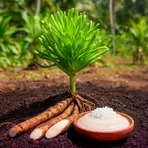
A plant with long edible roots grown for its starch used to make tapioca
Surface Forms
Morphology
The phrase is a straightforward adjective+noun composition: 'sweet' describes a type of 'cassava', so a learner who knows both words would infer it refers to a variety of cassava characterized by sweetness or edible (less toxic) roots. This follows a common, cross-linguistic modification pattern and does not require idiomatic knowledge.
Etymology
The noun sweet cassava comes from farmers calling a type of cassava sweet because its roots are 'less toxic' and need little work before cooking. That's why sweet cassava today means a kind of cassava you can eat as a 'vegetable' and whose leaves are safe as 'animal feed'.