
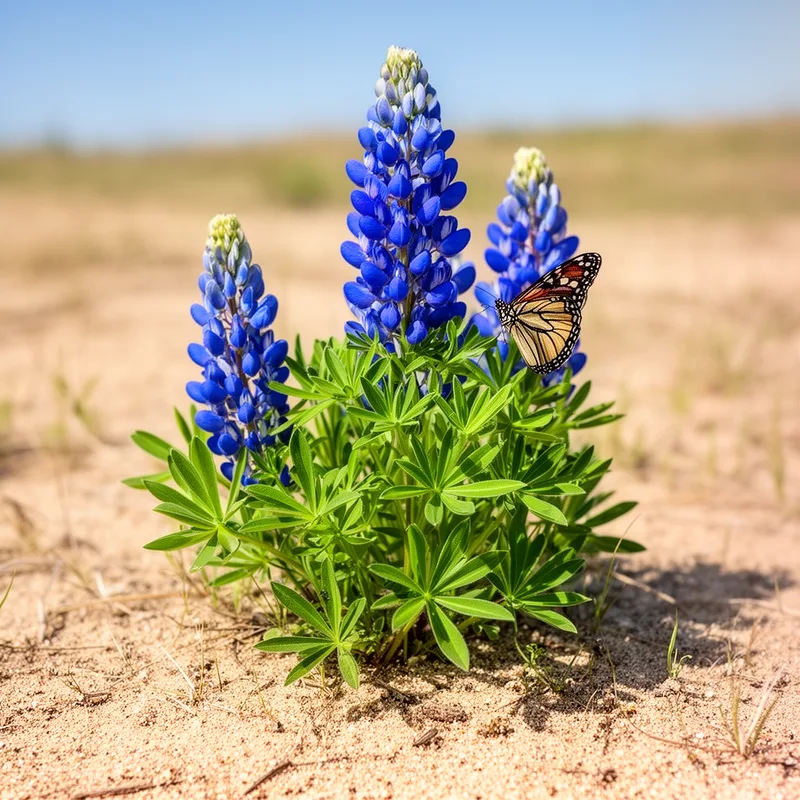
Lupinus perennis
- noun
- /ˈluːpɪnəs pəˈrɛnɪs/
- Specialized
- Monarch butterflies often lay their eggs on patches of Lupinus perennis.
Examples
-
Many gardeners choose Lupinus perennis for its vibrant blue flowers.
-
The sandy soils of the prairie are ideal for growing Lupinus perennis.
-
Conservationists are working to restore Lupinus perennis habitats to support endangered species.
-
The Lupinus perennis blooms beautifully in the spring.
-
Conservationists are working to restore Lupinus perennis habitats to support endangered species.
-
Monarch butterflies often lay their eggs on patches of Lupinus perennis.
-
Many gardeners choose Lupinus perennis for its vibrant blue flowers.
Synonyms
A plant that grows in eastern North America with leaves like a hand and groups of blue flowers
A hardy plant that has blue flowers in long groups and leaves shaped like a hand

A strong, long-lived flowering plant with blue flowers that grows in eastern and central North America

A strong plant from eastern and central North America that lives many years with palm-like leaves and blue flowers
Surface Forms
Morphology
Lupinus + perennis
This is a standard botanical binomial where the first element names the genus (Lupinus = lupin) and the second is a Latin epithet (perennis = perennial). If a learner knows both constituents, the meaning 'a perennial lupin' is directly derivable from combining genus + epithet, following a regular and cross-linguistically familiar taxonomic pattern.
Etymology
Lupinus perennis may come from Latin: Lupinus comes from the word 'wolf' because people long ago thought these plants made the soil worse, and perennis means 'lasting many years', so the name points to a wild lupine that people thought harmed the soil and that lives for many years.

