
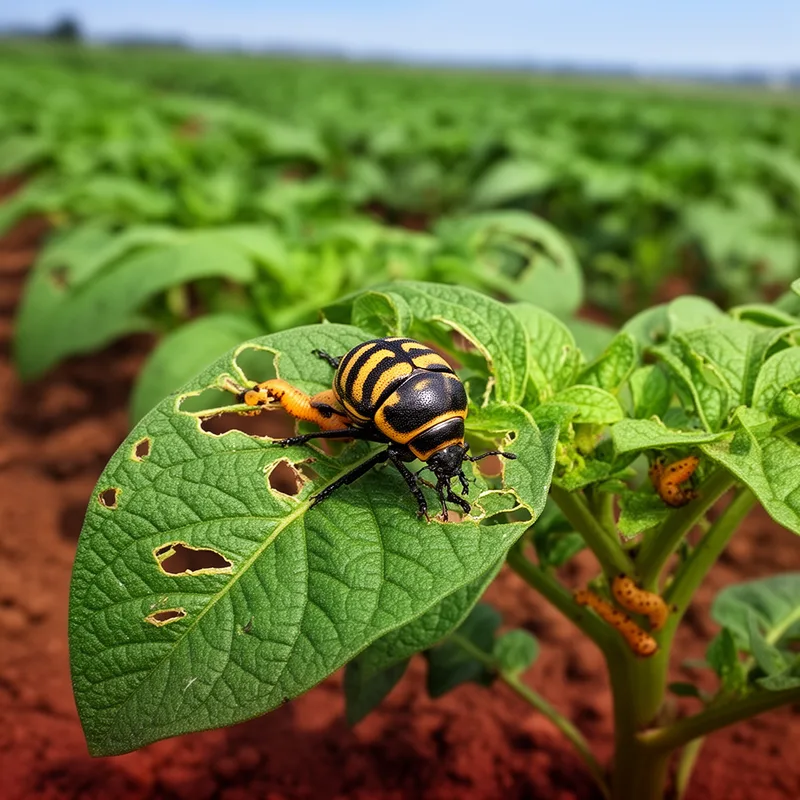
Leptinotarsa decemlineata
- noun
- Specialized
 :
Leptinotarsa decemlineata
:
Leptinotarsa decemlineata
- The larvae of Leptinotarsa decemlineata can quickly defoliate potato crops if left unchecked.
Examples
-
Farmers monitor their fields carefully to detect infestations of Leptinotarsa decemlineata.
-
Chemical pesticides are often used to control Leptinotarsa decemlineata populations in agricultural areas.
-
The Leptinotarsa decemlineata is a significant pest for potato farmers.
-
Have you seen a Leptinotarsa decemlineata on your plants?
-
Farmers use various methods to manage Leptinotarsa decemlineata infestations on their potato plants.
-
The bright colors of the Leptinotarsa decemlineata serve as a warning to predators about its potential toxicity.
-
To prevent damage, it is crucial to inspect for Leptinotarsa decemlineata early in the growing season.
Synonyms
 1
4.8
1
4.8

A black and yellow beetle that eats potato plants
 1
7.0
1
7.0
A black-and-yellow beetle that eats potato leaves when young and as an adult
 1
5.7
1
5.7
A black and yellow beetle that eats potato leaves

 1
7.5
1
7.5
A small insect with black and yellow stripes that eats potato leaves and harms crops
Surface Forms
Morphology
Leptinotarsa + decemlineata
This is a Latin binomial (scientific name) functioning as a fixed taxonomic label rather than a compositional English phrase; knowing the genus and an uninterpretable species epithet does not let a B1 learner infer the common meaning 'Colorado potato beetle'. The species epithet 'decemlineata' is not a standard English word for learners and the mapping from Latin labels to common referents is arbitrary, so the overall meaning is not derivable from the parts.
Etymology
Leptinotarsa decemlineata comes from old Latin words decem and lineata, which mean 'ten' and 'lined' because the beetle has ten yellow and black stripes on its back. This black-and-yellow insect eats potato leaves, so the name helps you remember the common 'potato beetle' that can damage crops.