

J particle
- noun
- Specialized
- The discovery of the J particle in 1974 confirmed the existence of the charm quark.
Examples
-
The mass of the J particle is significantly greater than that of most other mesons.
-
Physicists studied the decay patterns of the J particle in high-energy experiments.
-
The J particle was discovered in 1974.
-
Scientists are studying the properties of the J particle.
-
Physicists studied the decay patterns of the J particle in high-energy experiments.
-
The discovery of the J particle in 1974 confirmed the existence of the charm quark.
-
The mass of the J particle is significantly greater than that of most other mesons.
Synonyms
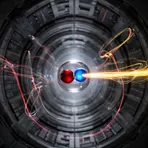
A heavy neutral meson made of a quark and an antiquark seen in physics experiments
Surface Forms
Morphology
J + particle
This is a technical proper name: 'J' is just a letter/symbol (no lexical meaning given) and 'particle' is a generic noun, so the specific referent (the J/psi meson) and its properties are not derivable from the parts. Understanding requires domain-specific physics knowledge or prior exposure, so a B1 learner who only knows the constituents would not infer the MWE meaning.
Etymology
J particle gets its name from the 1974 discovery when two teams found the same heavy particle; one team called it J because a quick mark in a scientist's notebook looked like the letter J, while the other called it psi. So the particle became known as 'J/psi', and that is why people now say J particle.

