
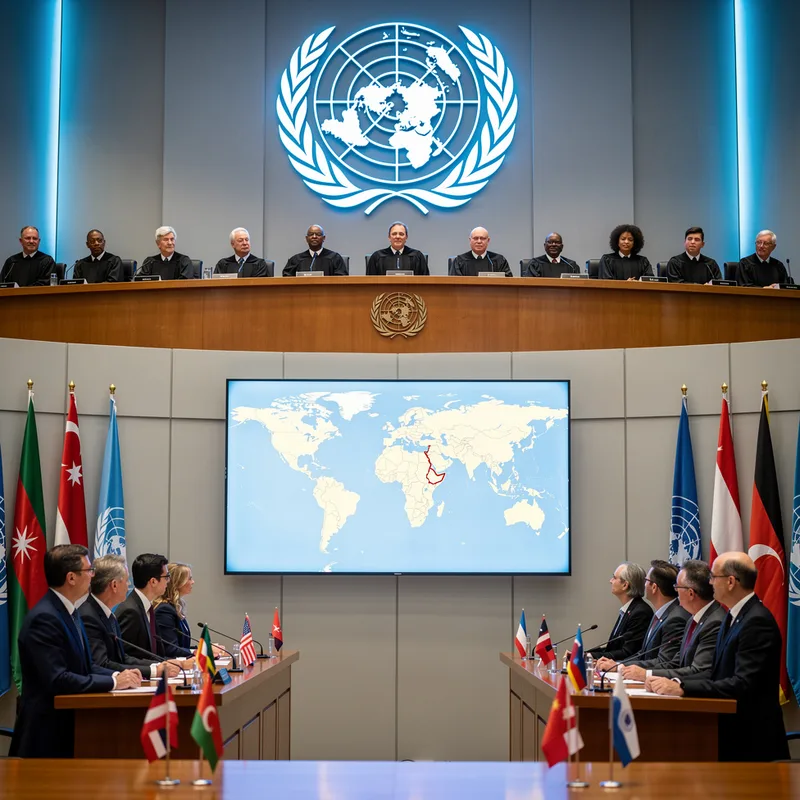
International Court of Justice
 2
4.2
2
4.2

- proper noun
 :
Corte Internacional de Justicia
:
Corte Internacional de Justicia
- As confirmed by the International Court of Justice in the Nicaragua judgment, "the element of coercion... forms the very essence of prohibited intervention." 91
- International Court of Justice (ICJ)
- judges of the International Court of Justice
Examples
-
The International Court of Justice helps resolve disputes between countries through legal means.
-
The secret negotiation history of any international agreement is generally disregarded by the International Court of Justice.
Academic text (2000) -
Only states have seats in the United Nations, and only states may be parties in suits before the International Court of Justice.
Academic text (2003) -
Professor Baxter later became a judge on the International Court of Justice, but died soon thereafter.
Academic text (2000) -
One such example is the 1986 decision of the International Court of Justice in the case Nicaragua v. United States.
Academic text (2009) -
Israel's abuses have been confirmed by the United Nations Security Council and the International Court of Justice.
Blog text (29) -
The International Court of Justice again faced the issue of territorial sovereignty in its 1986 Nicaragua judgment.
Academic text (2017) -
Since Berne and the other copyright treaties are public law, the only recourse between countries is the International Court of Justice.
Academic text (1999) -
The principle of non-intervention, as part of customary international law, was confirmed by the International Court of Justice in the Nicaragua case of 1986.
Academic text (1994) -
Article 38(1) part (a) of the Statutes of the International Court of Justice (ICJ) is used as a reference and source of international law.
Academic text (2017)
Synonyms
 76
3.2
76
3.2
A place where a judge hears and decides cases about the law
 3
5.0
3
5.0
An international court that settles disputes between countries and gives advice on international law
 2
3.8
2
3.8
A place where judges decide legal cases and apply the law
Surface Forms
Morphology
international + court + of + justice
A B1 learner who knows 'international' (between countries), 'court' (a tribunal for legal cases) and 'justice' (judicial authority) can readily infer this is a judicial body that deals with legal matters between countries. The compound follows a clear, cross-linguistically common composition pattern (adjective + noun + noun) so the general meaning is directly derivable, even if the precise status as the UN's principal court is a specific factual detail.
Etymology
International Court of Justice literally means a single court where countries go to seek justice together. It was set up after World War II so nations could solve big problems by law instead of war, so today it 'decides disputes between states' and 'gives legal advice' to the United Nations.