

Hz
 7
3.7
7
3.7

- noun
- Specialized
- Television screens typically refresh at rates of 60 Hz or higher for smoother images.
- frequency in Hz
- 60 Hz
- 1000 Hz
Examples
-
Average values of NIBcoh were calculated by averaging the coherence over the full 15-35 Hz frequency range.
Academic text (2011) -
The system bandwidth was 150 to 1000 Hz with an overall gain of 1000.
Academic text (1990) -
The largest error was 1.6 Hz among the remaining five subjects.
Academic text (1991) -
Readings were calculated by averaging samples taken at 10 Hz for 5 seconds.
Academic text (1990) -
For a sine tone of intermediate frequency, such as 2000 Hz, neither cue works well.
Academic text (1999) -
The peak near 7000 Hz is thought to be a particularly prominent cue for a source overhead.
Academic text (1999) -
The sampling frequency was 50 Hz, and waveforms were recorded and displayed on an Apple Macintosh SE30 computer.
Academic text (1999) -
Psychoacoustical experiments show that human listeners can localize a 500 Hz sine tone with considerable accuracy.
Academic text (1999) -
Signals were conditioned by amplification, filtering with a 33 Hz roll-off, and conversion from analog to digital.
Academic text (1991) -
Furthermore, although chewing elicited high 20- to 60-Hz coherence measured bilaterally from the masseters, these levels were reduced during speech.
Academic text (2011)
Synonyms
 19
8.0
19
8.0
A measure of frequency equal to one hertz
 5
4.8
5
4.8
A unit for measuring how many times a sound or light wave repeats each second
 2
4.1
2
4.1
A unit for frequency equal to one complete cycle in one second
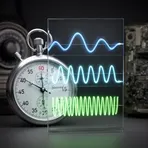
A unit that measures how many times something repeats each second
How Fast

Surface Forms
Etymology
Hz is short for hertz, named after the German scientist Heinrich Hertz, who studied waves. So when we say '50 Hz' we mean 50 'cycles per second', which is counting how many times something repeats each second.