
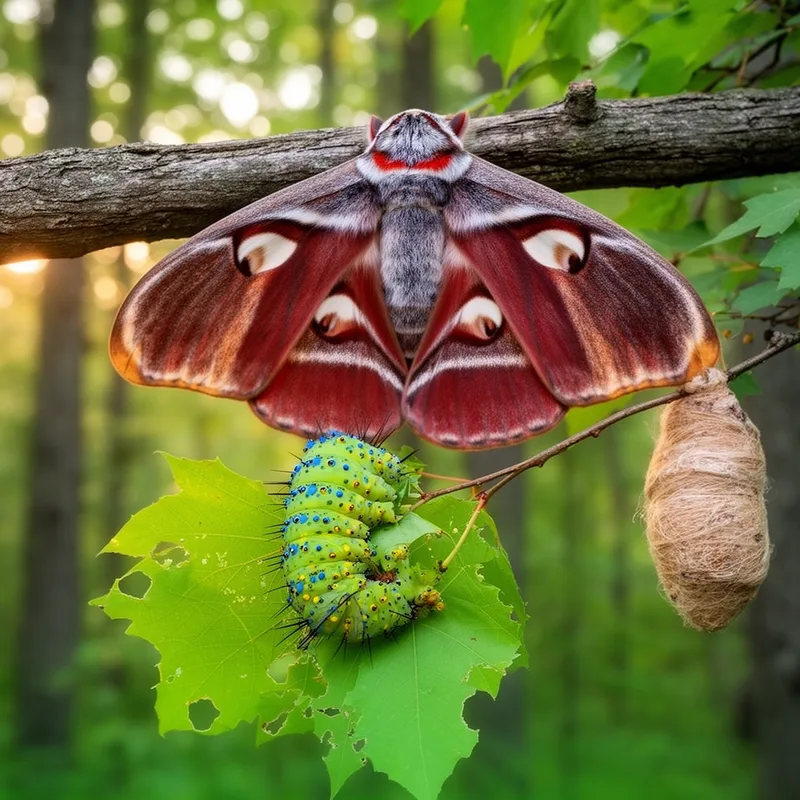
Hyalophora cecropia
- noun
- /ˌhaɪəˈlɒfərə sɪˈkroʊpiə/
- Specialized
- The Hyalophora cecropia is the largest native moth in North America, with a wingspan of up to six inches.
Examples
-
I saw a Hyalophora cecropia cocoon attached to the branch of a maple tree in the park.
-
Scientists study Hyalophora cecropia to learn about insect development and metamorphosis.
-
The Hyalophora cecropia is one of the largest moths in North America.
-
Have you ever seen a Hyalophora cecropia in the wild?
-
The Hyalophora cecropia is a large moth known for its striking coloration and size.
-
During the summer, you might spot a Hyalophora cecropia larvae munching on the leaves of a cherry tree.
-
The lifecycle of the Hyalophora cecropia includes an impressive transformation from caterpillar to moth.
Synonyms

A large moth in North America with red-brown wings and eye-like spots whose caterpillars eat tree leaves
A large North American moth with brown and red wings whose caterpillars eat tree leaves
Surface Forms
Morphology
This is a scientific binomial combining a genus name (Hyalophora) with a species epithet (cecropia); if a learner knows that Hyalophora refers to silkworm moths and cecropia denotes a large moth, they can infer this is a particular moth species. The label is compositional and non-idiomatic (taxonomic naming is cross-linguistically recognizable), so its meaning is readily derivable from the parts.
Etymology
Hyalophora cecropia may come from old Greek words hyalo 'glass' and phora 'to carry', giving the picture of a moth 'carrying' bright, glass-like spots on its wings, while cecropia is a name from an old Greek story that early scientists used. That's why the name fits this large North American moth with shiny patches on its wings.

