

Great War
 14
4.2
14
4.2

- noun
- /ɡreɪt wɔr/
- The Great War, also known as World War I, marked a significant turning point in global history.
- the Great War of 1914
- the Great War 1914-1918
- soldiers of the Great War
Loading YouTube…
Watch on YouTubeYes, lots and lots of soldiers in the Great War were seriously superstitious.
- Yes, lots and lots of soldiers in the Great War were seriously superstitious.
- And my dad fought in the popular war, the one that was the Great War.
- Viva L Italia Since the Great War ended, he has been positioning himself as the man who has the solution to the post war chaos raging in Italy.
- But if you want to, you can subscribe to the Great War newsletter now.
- Tonight she will be speaking to hers on another intersection between the classics and the modern world in a talk called The Great War and the Ancient World.
Examples
-
He was a brave soldier in the Great War.
-
- What, the Great War?
-
My brother cut them off a dead German at the Great War's end.
Fiction book (1996) -
- I remember the Great War in 1914.
-
Big battles there in the Great War.
-
Not all the elements of the decades before the Great War are currently in play in the international arena.
Academic text (2015) -
"An indictment of the Great War and what it did to Germany."
Fiction book (1998) -
I died from bayonet wounds in the Great War.
-
Asquith's eldest son, his most brilliant son, Raymond, he was killed in the Great War.
-
German humiliation in the aftermath of the Great War led to political disintegration.
Academic text (1998)
Synonyms
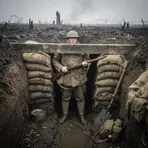 24
2.8
24
2.8
A large war in Europe from 1914 to 1918 between many countries, also called World War I
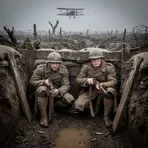 12
3.0
12
3.0
A global war fought mainly in Europe from 1914 to 1918 between the Allies and Central Powers
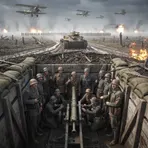 2
3.0
2
3.0
A large war that many countries fought from 1914 to 1918
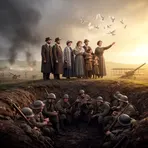
A name for World War I used by people who hoped it would stop future wars
Surface Forms
Morphology
The combination of 'great' (major, significant) + 'war' transparently yields the sense 'a very large or important war', so a B1 learner who knows the words will infer a general meaning. However, identifying this fixed phrase specifically as the historical event World War I requires cultural/historical knowledge and conventional naming, so the mapping is not fully predictable despite cross-linguistic parallels (e.g. Grande Guerre).
Etymology
Great War was the name people used because great meant 'very large' or very important, and it was the biggest war they had seen by 1918. That's why Great War refers to the war we now call World War I.