
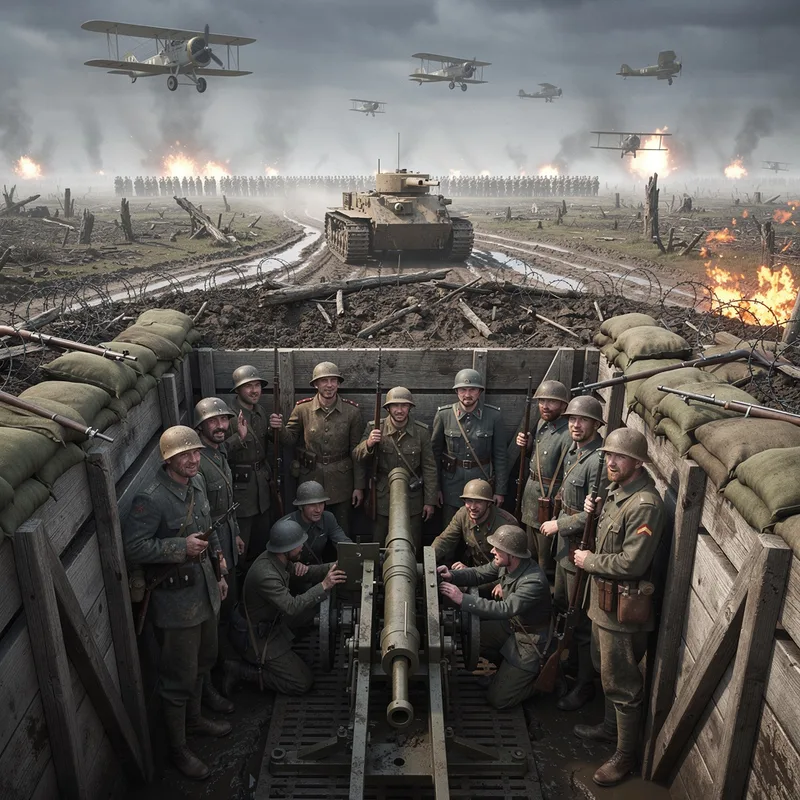
World War I
 2
3.0
2
3.0

- proper noun
- /wɜrld wɔr wʌn/
- Direct negotiations between Arabs and Jews after World War I foundered.
Examples
-
This practice began before World War I and continued until the 1960s.
Academic text (1996) -
The CPI was designed in 1919 because prices had risen during World War I to provide an index for cost-of-living adjustments for workers' wages.
Academic text (2009) -
"During World War I, men would have spent much of their lives down here.
Academic text (2009) -
A century later, World War I, which in fact was largely a European war, drew in the United States from across the Atlantic.
Academic text (2009) -
Anti-German feeling ran especially high during World War I.
Academic text (1996) -
On the eve of World War I, the key players in the European balance of power were more or less evenly matched.
Academic text (2009) -
With fighting still raging on World War I's Western Front, the Allies were desperate for Russia to rejoin the struggle against Germany.
-
For several hundred years leading up to World War I, all of Israel, the Kingdom of Jordan, and the putative state of Palestine were merely provinces of the Ottoman Empire.
Academic text (2009) -
As leader of American Zionism right after World War I, Brandeis protested the heavy subsidization of the socialist endeavors in Palestine.
Academic text (1996) -
Sunday marked the 100th anniversary of the end of World War I.
Synonyms
 24
2.8
24
2.8
A large war in Europe from 1914 to 1918 between many countries, also called World War I
 14
4.2
14
4.2
A war in Europe from 1914 to 1918 between the Allies and Central Powers
 12
3.0
12
3.0
A global war fought mainly in Europe from 1914 to 1918 between the Allies and Central Powers
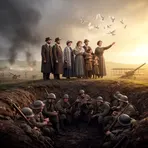
A name for World War I used by people who hoped it would stop future wars
Surface Forms
Morphology
The phrase is directly compositional: 'world' (global) + 'war' (armed conflict) + 'I' (the Roman numeral one) yields the idea of the first global war, so a learner who knows the constituents can infer it refers to the first large-scale/worldwide war. Although precise dates and parties are not contained in the words, the core referent and the numbering convention are predictable and cross-linguistically common.
Etymology
World War I gets its name because the fighting involved many countries across the world, so people called it a 'world war'. After a second great conflict happened, people began to add 'I' to show it was the 'first world war'.