

Great Charter
- proper noun
- Formal
- In so doing, it threatens to undermine the long-term health of the unique polity established by that great charter.
Examples
-
I recognize that many of my colleagues on the bench firmly believe that, in adapting the Constitution to fit changing circumstances, they are accomplishing the true aim of that great charter.
Academic text (2003) -
But that reasoning cannot be applied to this great charter.
Academic text (2003) -
The Great Charter of the Liberties
Blog text (2) -
The best way to start any reexamination of the value of property rights under our Constitution is to begin with the English common law. For example, given that thirty-eight of the sixty-three articles in Magna Carta protected feudal property rights, it can safely be said that the Great Charter was an important recognition of the need to protect those interests.
Academic text (2016) -
The Great Charter laid the foundation for modern democracy by establishing the principle that everyone, including the king, is subject to the law.
-
Historians often refer to the Great Charter as a crucial document in the struggle for individual rights against arbitrary authority.
-
In 1215, the English barons presented their demands to King John, resulting in the signing of the Great Charter.
Synonyms
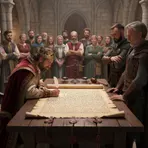
 2
7.7
2
7.7

An important 1215 document that limits the king's power and gives people legal rights
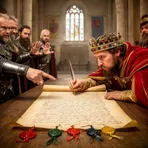
A royal document from 1215 that limits the king's power
Surface Forms
Morphology
The components 'great' (important) and 'charter' (a formal document) transparently yield the general idea of an important or significant charter, so a B1 learner who knows the words would grasp its basic sense. However, the specific historical referent (the Magna Carta of 1215 and its precise political meaning) is a fixed, culturally specific name that cannot be fully derived from the constituents, so full comprehension requires prior knowledge.
Etymology
Great Charter comes from the name 'Magna Carta' and tells a famous story: in 1215 King John was forced by rebel barons to sign a written agreement at Runnymede that limited the king's power. That's why the Great Charter is seen as an early source of 'rights' and 'freedom' in later laws.