
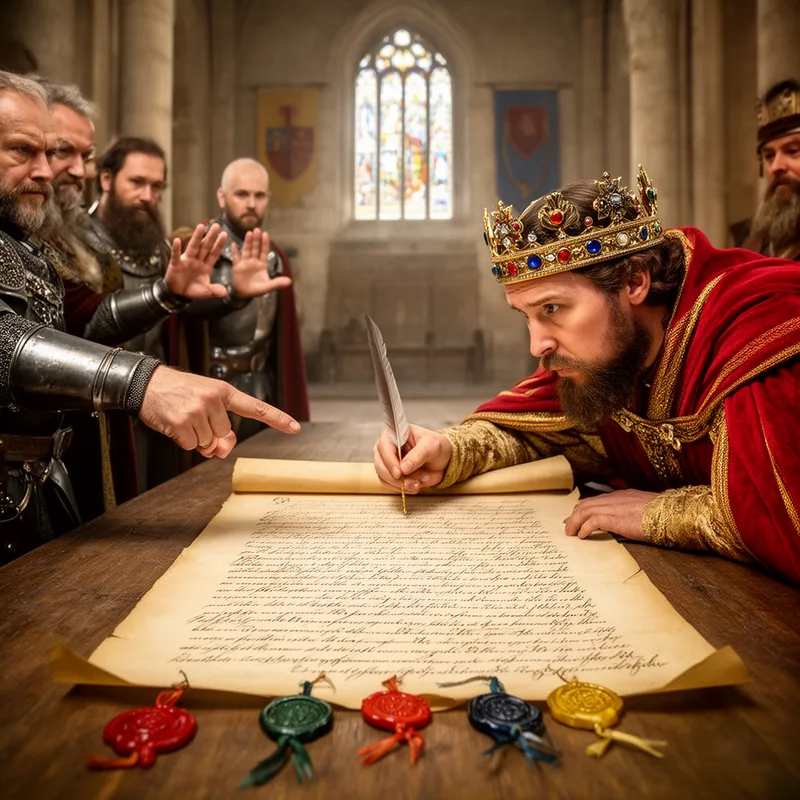
Magna Charta
- proper noun
- /ˈmæɡnə ˈkɑrtə/
- UK
- The Magna Charta was signed in 1215, establishing important principles of justice and individual rights.
Examples
-
From the Magna Charta to the Declaration of Independence, it was universally recognized that God himself is the author of just laws and the guarantor of rights and liberty.
Blog text (27) -
To have followed, as in the state constitutions and in the ordinance of 1787, the words of Magna Charta, and declared that no person shall be deprived of his life, liberty, or property but by the judgment of his peers or the law of the land, would have been in part superfluous and inappropriate.
Academic text (2017) -
The words, "due process of law," were undoubtedly intended to convey the same meaning as the words, "by the law of the land," in Magna Charta.
Academic text (2017) -
"'T is an inevitable chance—the first statute in Magna Charta—it is an everlasting act of Parliament, my dear brother.
Academic text (1990) -
Historians agree that the Magna Charta laid the groundwork for modern democracy in England.
-
Many consider the Magna Charta a crucial step in limiting the power of the monarchy.
Synonyms
 2
7.7
2
7.7

An important 1215 document that limits the king's power and gives people legal rights

 1
8.1
1
8.1
An official document from a king or queen that gives rights to an organization

A royal document giving political rights to English barons in 1215
Surface Forms
Morphology
Magna + Charta
The phrase is a literal Latin composition (magna = 'great', charta = 'charter'), so a learner who knows the constituent meanings can infer it denotes an important or great charter document. While historical and legal specifics (signed in 1215, role in constitutional history) are not deducible from the words alone, the basic referent is transparently built from the parts.
Etymology
Magna Charta comes from old Latin words: Magna means 'great' and Charta means 'charter' or a written promise. In 1215, rich landowners forced King John to accept this 'great charter' to limit the king's power and protect some 'rights', so today Magna Charta stands for limits on rulers and basic rights.