

Magna Carta
 2
7.7
2
7.7

- noun
- /ˈmæɡnə ˈkɑrtə/
- Since I'm studying English history, I really enjoyed Magna Carta.
- Magna Carta (1215)
- Magna Carta clause
- sign the Magna Carta
Loading YouTube…
Watch on YouTubeThe barons at Magna Carta, although they speak runnymed, although they speak French, they're calling themselves English and they're clamouring for the rights of Englishmen.
- The barons at Magna Carta, although they speak runnymed, although they speak French, they're calling themselves English and they're clamouring for the rights of Englishmen.
- Do we really care about the Magna Carta or the always dream of being one of a billion breathing comets crashing around the Tropic Scientific expedition?
Examples
-
The students began their involvement with big ideas with the Magna Carta:
Academic text (1991) -
However, the reputation of Magna Carta has grown through the years so as to supposedly provide the source for other rights such as due process, no taxation without representation, and equality of rights before the law.
Academic text (1991) -
What became important was not the actual language of Magna Carta, but what it stood for.
Academic text (1991) -
While the Magna Carta did set forth certain rights and obligations, its most important provision was a prohibition on the king imposing new taxes without the consent of the governed.
Academic text (1991) -
Magna Carta (1215) is most often cited as the document that provided the first protections of individual liberties.
Academic text (1991) -
The NDAA basically did away with the Fifth Amendment and the concept of habeas corpus, which has been with us since the signing of the Magna Carta.
Blog text (2) -
The strategy of adopting seriatim lists to allege political wrongdoing and to assert political entitlements is embedded in the English political tradition, going back to Magna Carta.
Academic text (2008) -
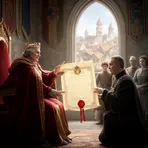
The Magna Carta was signed in 1215 to limit the powers of the English monarchy.
-
Many scholars believe the Magna Carta laid the foundation for modern democracy.
-
The principles outlined in the Magna Carta are still relevant in today’s discussions of human rights.
Synonyms

 1
8.1
1
8.1
An official document from a king or queen that gives rights to an organization

A royal document from 1215 that limits the king's power

A royal document giving political rights to English barons in 1215
Surface Forms
Morphology
Magna + Carta
The phrase is a Latin proper name literally meaning 'Great Charter' — if a learner knew the constituents they would likely infer it refers to an important document, but not the specific historical/legal significance (the 1215 charter limiting royal power). As a culture- and history-specific proper noun whose full meaning requires background knowledge beyond literal composition, it is only partially transparent to B1 learners.
Etymology
Magna Carta comes from Latin: Magna means 'great' and Carta means 'charter' or 'paper'. In 1215 a group of powerful nobles forced King John to accept a large written list of rules that limited the king's power, so the 'Great Charter' became a symbol of legal rights and limits on rulers.