
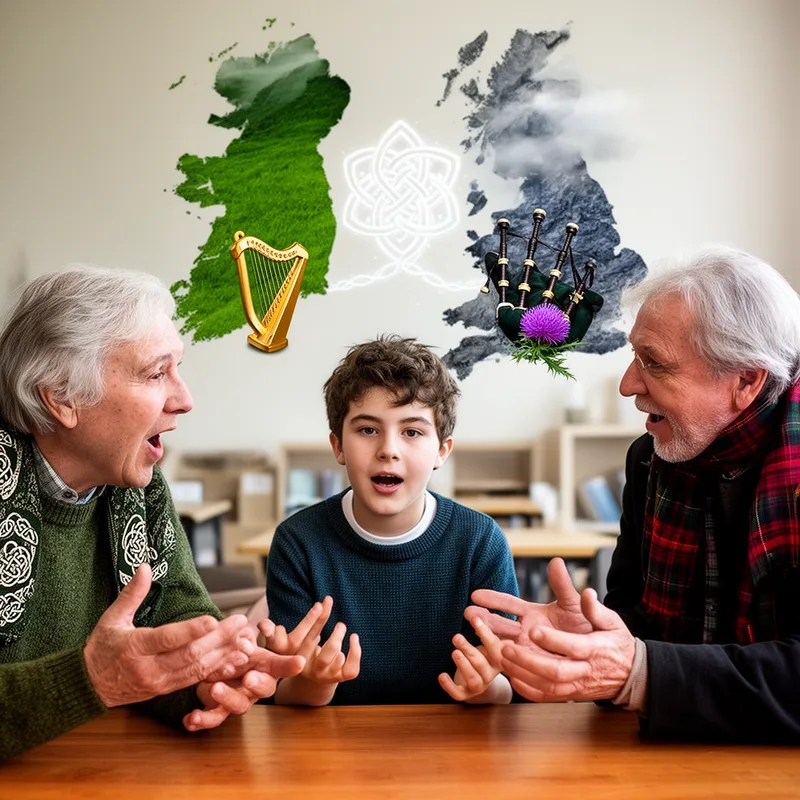
Gaelic language
- noun
- /ˈɡeɪlɪk ˈlæŋɡwɪdʒ/
- Learning the Gaelic language opens up a deeper understanding of Irish and Scottish traditions.
Examples
-
The Erse Gaelic language was never written until very recently for the purposes of religion.
Academic text (2011) -
The Irish are Gaelic in origin, and the Gaelic language has as much to do with English as it does with Russian.
Blog text (13) -
Hunger was used to win converts, particularly in areas where the Gaelic language was strongest; "relief was second only to education as a weapon in the battle for the minds and hearts of the Irish poor" (I. Whelan 1995: 135, 140).
Academic text (2001) -
The Gaelic language is still spoken in parts of Ireland and Scotland, preserving its rich cultural heritage.
-
Many students in Scotland are encouraged to study the Gaelic language to keep it alive for future generations.
Synonyms

 4
9.3
4
9.3

A language from the Celtic family spoken in Scotland or Ireland

A Gaelic language spoken in Scotland and Ireland, especially Scottish Gaelic
A name for the Gaelic languages of Ireland and Scotland

A group of Celtic languages like Irish, Scottish Gaelic, and Manx spoken in Ireland, Scotland, and the Isle of Man
Surface Forms
Morphology
The meaning is directly compositional: 'Gaelic' denotes a Celtic language and 'language' names a spoken/written system, so together they explicitly refer to the Gaelic language(s). This ‹X language› naming pattern is cross-linguistically common and immediately understandable to a B1 learner who knows both constituents.
Etymology
The name Gaelic language comes from the people called the Gaels, who lived in Ireland and Scotland long ago. So Gaelic language means 'the language of the Gaels' and today refers to the Irish and Scottish versions of that language.