

Fusarium wilt


 1
7.4
1
7.4
- noun
- /fjuˈzɛr.i.əm wɪlt/
- Specialized
 :
marchitez por Fusarium
:
marchitez por Fusarium
- The research team discovered that Fusarium wilt can significantly reduce crop yields if left untreated.
- Fusarium wilt disease
This could be like Fusarium wilt.
- This could be like Fusarium wilt.
Examples
-
Farmers are concerned about the impact of Fusarium wilt on their crops, as it causes leaves to wilt and yellow.
-
We also use the information to pinpoint outbreaks of plant diseases such as Fusarium wilt and vine decline.
Academic text (1996) -
"A lot depends on the conditions in their fields, such as whether the fields have a history of Fusarium wilt."
Blog text (13) -
These cultivars were also among the most resistant to Fusarium wilt in both years of field tests.
Blog text (13) -
The more resistant a variety is to Fusarium wilt, the more likely it is that the plant will avoid becoming infected and go on to produce plenty of pollen.
Blog text (13) -
It was resistant to the most serious watermelon diseases: anthracnose and fusarium wilt.
Academic text (1994) -
Significant correlations occurred between the rankings of the cultivar's Fusarium wilt reactions in both the two field and three greenhouse experiments, indicating
Blog text (13) -
The study found that several other varieties were even more resistant to Fusarium wilt, including 'Ace' and 'Pinnacle'—but they produced fewer male flowers.
Blog text (13) -
Third, they wanted to know which pollenizers are most resistant to a fungal infection of the roots called Fusarium wilt—which can kill a plant.
Blog text (13) -
To manage Fusarium wilt, scientists recommend rotating crops and using resistant plant varieties.
Synonyms
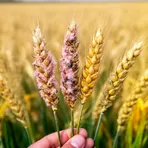
A plant disease caused by a fungus that damages crops like wheat
Surface Forms
Morphology
The term is a straightforward composition of the pathogen name 'Fusarium' and the disease type 'wilt'; a learner who knows Fusarium (a plant-infecting fungus) and wilt (drooping/shriveling of plant tissues) can infer it means the wilt caused by Fusarium. This organism+disease naming pattern is common in biology and across languages, making the meaning directly derivable from the constituents.
Etymology
Fusarium wilt is named for the fungus Fusarium and the word wilt. The fungus lives in the soil and attacks the roots so the plant cannot take up water, making leaves droop and turn yellow, so the name describes a fungus that makes plants 'wilt'.