
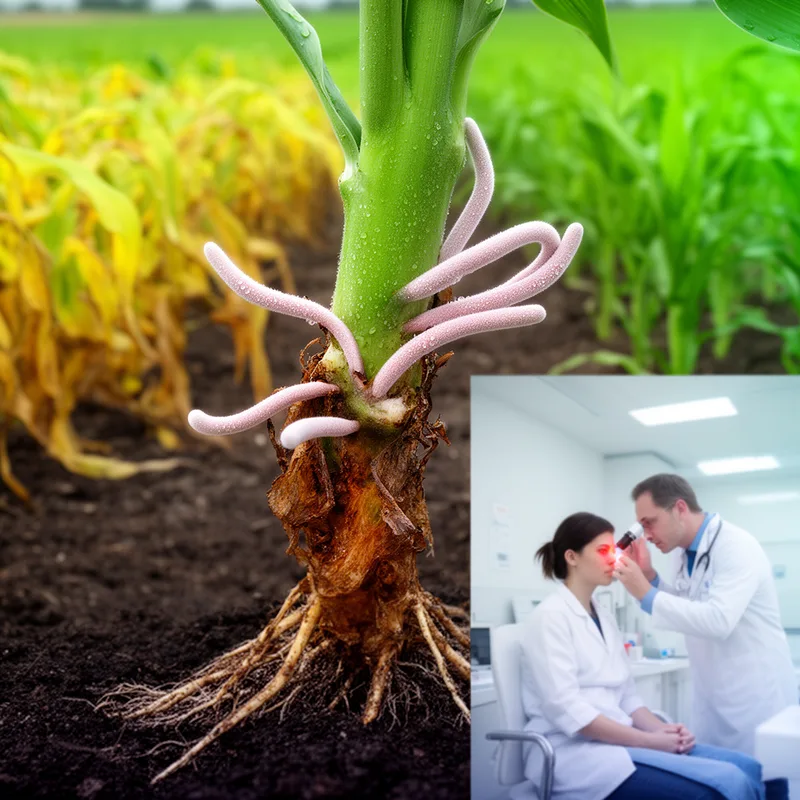
Fusarium
 1
9.9
1
9.9

- noun
- /fjuˈzɛr.i.əm/
- Specialized
 :
Fusarium
:
Fusarium
- Kistler and O'Donnell are among scientists researching toxin-producing Fusarium fungi.
- Fusarium fungi
- Fusarium infections
- fusarium wilt
So this could be bacterial wilt, this could be Fusarium wilt, this could be things like damping off.
- So this could be bacterial wilt, this could be Fusarium wilt, this could be things like damping off.
- This could be like Fusarium wilt.
Examples
-
Furthermore, recent studies have suggested that nondermatophyte fungi (including Fusarium spp.) are emerging as causes of onychomycosis (14-16).
Academic text (2013) -
Here, scientists work with a bacteria that may help prevent Fusarium fungi from infecting corn used for animal feed.
Academic text (2003) -
Until now, most scientists throughout the world have had to use visual means to identify Fusarium pathogens.
Academic text (2000) -
For plant breeding programs to be fully effective, for example, breeders need to take into account all eight Fusarium species.
Academic text (2000) -
One possibility for an increase in Fusarium spp. in the environment is agricultural activities.
Academic text (2013) -
Wheat scab is caused by the fungus Fusarium graminearum.
Academic text (2006) -
The Fusarium microbe can also cause root, stalk, and ear rots in corn.
Academic text (1999) -
We also use the information to pinpoint outbreaks of plant diseases such as Fusarium wilt and vine decline.
Academic text (1996) -
We also observed an increase in the incidence of superficial infections caused by Fusarium spp. in outpatient nonhematologic patients at the same hospital during the same period.
Academic text (2013) -
Agricultural practices can significantly increase the prevalence of Fusarium, which is known to harm crops.
Compounds

- Specialized

 1
7.4
1
7.4
A plant disease that makes leaves wilt and turn yellow, caused by a fungus called Fusarium
Surface Forms
Etymology
The word Fusarium comes from the Latin fusus, meaning 'spindle', a long, thin tool for spinning thread. That's why scientists gave this name to the fungus: it makes long, spindle-shaped spores, so the name points to its shape.